🎉 Start Shopify’s $1 Plan and We’ll pay you up to $3,600 just for starting! 💸 — Limited Time
Get Limited Time Offer 💰
Offer Details — Rewards require completing eligible third-party offers. Reward amounts vary from $30 to $3,600. Terms and eligibility restrictions apply.
🎉 Start Shopify’s $1 Plan and We’ll pay you up to $3,600 just for starting! 💸 — Limited Time
Get Limited Time Offer 💰
Offer Details — Rewards require completing eligible third-party offers. Reward amounts vary from $30 to $3,600. Terms and eligibility restrictions apply.
🎉 Start Shopify’s $1 Plan and We’ll pay you up to $3,600 just for starting! 💸 — Limited Time
Get Limited Time Offer 💰
Offer Details — Rewards require completing eligible third-party offers. Reward amounts vary from $30 to $3,600. Terms and eligibility restrictions apply.
Ecommerce Strategies
Welcome Email Templates for Shopify Dropshipping
Welcome Email Templates for Shopify Dropshipping

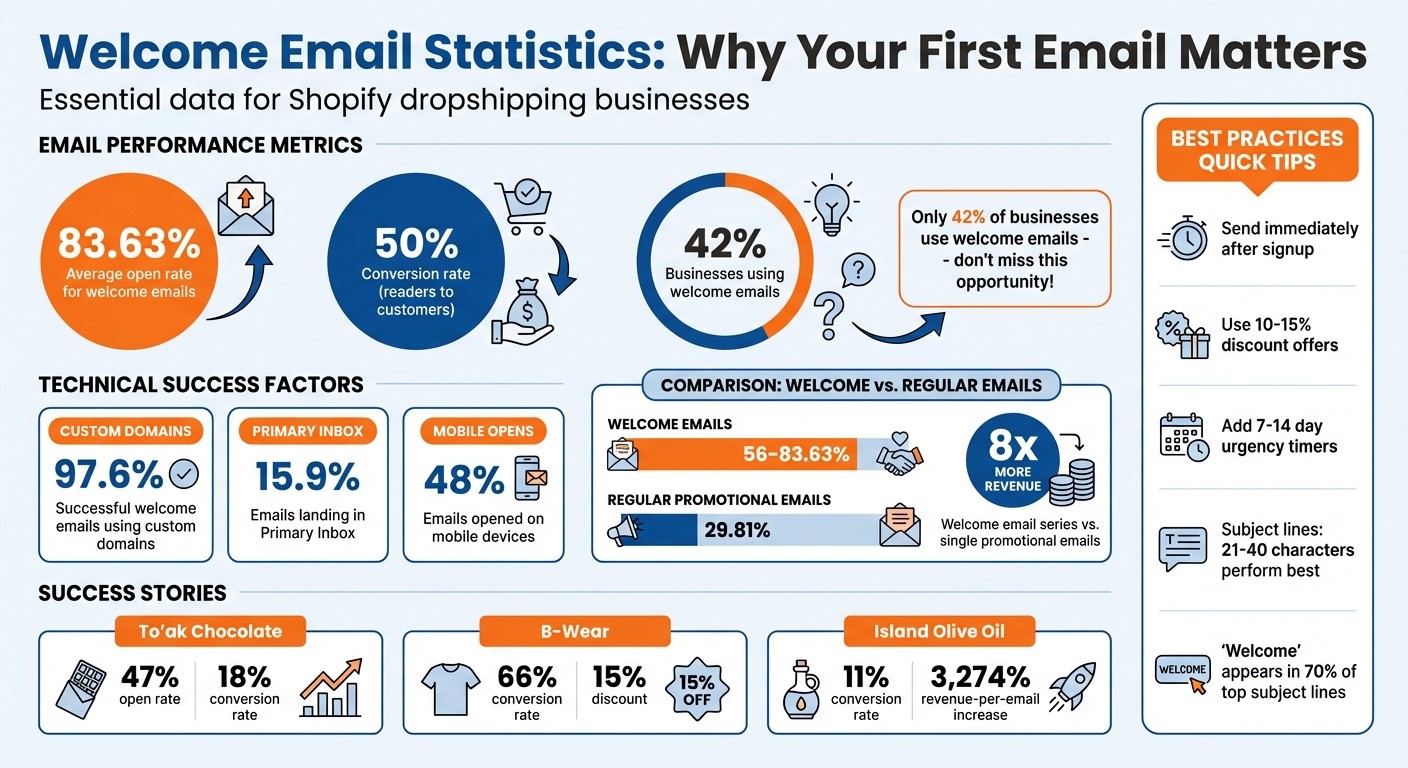
Your welcome email is your first chance to connect with new subscribers - and it’s a big deal. Why? These emails have an average open rate of 83.63% and can convert 50% of readers into customers. Yet, only 42% of businesses take advantage of this opportunity.
Here’s what you need to know to make your Shopify dropshipping welcome emails stand out:
Timing is key: Send your email immediately after someone subscribes to capture their attention at its peak.
Build trust: Share your brand story, include customer reviews, and link to policies like shipping and returns.
Drive sales: Offer a discount (e.g., 10-15%) or exclusive perks, and use urgency (e.g., “valid for 7 days”) to encourage quick action.
Keep it professional: Use a custom email domain (e.g., hello@yourbrand.com) to avoid spam filters and improve credibility.
To help you get started, here are four ready-to-use templates for different goals, from quick sales to building long-term connections. Plus, tips on personalizing your emails, automating them in Shopify, and testing for better results. Set up your first welcome email today and start turning subscribers into customers.
Welcome Email Statistics and Performance Benchmarks for Shopify Dropshipping
How To Create High Converting Welcome Series in 2025
What Makes a Good Welcome Email for Dropshipping
A good welcome email lays the groundwork for trust, encourages sales, and motivates action with timely incentives. In dropshipping, where building trust quickly is critical, every detail counts.
For starters, technical aspects matter. Did you know that 97.6% of successful welcome emails use a custom domain (like hello@yourbrand.com)? This simple step not only helps you avoid spam filters but also makes your brand appear more professional. However, only 15.9% of these emails actually land in the Primary Inbox - a hurdle worth addressing.
Personalization goes a long way. Including the subscriber's name in the subject line and ensuring your email is mobile-friendly can make a huge difference. Since 48% of emails are opened on mobile devices, a clean, responsive design is essential. Stick to a simple HTML layout to make your email feel more personal and less like a corporate ad.
How to Build Trust Fast
Trust is the cornerstone of any successful welcome email. One way to establish it? Share your brand story. Introduce yourself as the founder and explain the "why" behind your business. Ezra Firestone, CEO of Boom! By Cindy Joseph, suggests:
"What would be interesting as one of the first emails to send - which increases the intimacy between the brand and the subscriber, and it just works - is a 'meet the founder' or 'our story' email."
Adding customer testimonials and clear policy details can further reinforce your credibility. For instance, To'ak Chocolate used this approach in their automated welcome series, achieving a 47% open rate and an 18% conversion rate. These elements help new subscribers feel confident in your brand.
Once trust is established, it's time to focus on driving those first sales.
Using Discounts and Offers to Get First Sales
Discounts are a tried-and-true way to encourage first purchases. A 10% discount is a popular choice. Make sure your promo code is easy to spot and include a clear "Shop Now" button - this feature appears in 33.8% of high-performing welcome emails.
Timing is everything. Some brands offer discounts right away, while others wait until trust is built through storytelling. Greg Zakowicz, Senior Ecommerce Expert at Omnisend, advises:
"A single Shopify welcome email is effective, but a series delivers even better results. So start with a warm introduction highlighting your brand's story and values."
Take B-Wear, for example. They paired a 15% discount code with a message focused on community, leading to a 66% conversion rate for new subscribers. Island Olive Oil Company also saw success by incorporating high-quality imagery and a brand introduction video in their welcome sequence, achieving an 11% conversion rate and a 3,274% revenue-per-email increase.
Discounts aren’t your only option. Free shipping thresholds, hassle-free returns, or exclusive perks for new subscribers can also reduce hesitation and encourage purchases.
Adding Urgency to Your Emails
The moment someone signs up for your emails, they’re most likely to engage. That’s why urgency is a powerful tool in your welcome series. Adding a deadline - like "valid for 7 days" or "expires in 14 days" - can encourage quicker action. Without a specific timeframe, subscribers might forget about your offer altogether.
Visual cues like a countdown timer GIF in your email header can amplify this sense of urgency. You can also use subject lines that highlight time sensitivity, such as "Claim your discount before it expires", to boost open rates.
If you’re using a multi-email series, save your final email for a friendly reminder about the expiring offer. As Nina De la Cruz, Content Strategist at Getsitecontrol, explains:
"A well-timed nudge like this can be the difference between a casual visitor and a first-time buyer."
When crafting urgency-based messages, focus on the value subscribers might miss out on, rather than resorting to alarmist language that could send your email straight to the spam folder. A well-placed reminder can turn interest into action.
Free Welcome Email Templates You Can Use Now
Want to make a strong first impression and boost your Shopify dropshipping sales? These four ready-to-use email templates are designed to help you connect with subscribers, drive sales, and build trust. Each one has a specific purpose, whether it's encouraging quick purchases, sharing your brand story, or showcasing bestsellers.
Template 1: Single Email for Quick Sales
Perfect for promoting trending or seasonal products, this template uses urgency and an enticing discount to encourage immediate purchases.
Subject Line Options:
"Your 15% discount is inside – Hurry!"
"Welcome! Here's 15% off your first order 🎉"
"Thanks for joining – Claim your discount now"
Email Body:
Hi [First Name],
Welcome to [Your Store Name]!
To thank you for joining our community, we're giving you 15% off your first order. Use the code:
WELCOME15
👉 [Shop Now]
Hurry - this offer is only valid for 14 days.
Got questions? Just reply to this email - we're here to help.
Cheers,
[Your Name]
[Your Store Name]
Why it works:
This email keeps it simple: the discount is front and center, the call-to-action is clear, and the limited-time offer creates urgency. As Desirae Odjick, Senior Product Marketing Lead at Shopify, puts it:
"Always set up the welcome email automation. Make sure that when someone decides to take that step and gives you their email address, you're ready to welcome them."
Template 2: 3-Email Welcome Series
If you're looking to build a deeper connection with your audience, a 3-email series can help establish trust and encourage long-term engagement. Spread the emails over 5–7 days for maximum impact.
Email 1 (Sent Immediately): Welcome + Discount
Subject Line:
"Welcome to [Store Name] – Here's a gift for you 🎁"
Hi [First Name],
Thanks for joining [Store Name]!
To get you started, enjoy 15% off your first order with code WELCOME15. Use it within 14 days.
👉 [Start Shopping]
Talk soon,
[Your Name]
Email 2 (Sent 2–3 Days Later): Brand Story or Bestsellers
Subject Line:
"We'd like to share our story"
Hi [First Name],
[Store Name] started with a passion for [briefly describe your inspiration]. Our mission? [state your mission or unique value].
Every product is thoughtfully curated to deliver quality and value. Ready to explore?
👉 [Shop Bestsellers]
Thanks for being here,
[Your Name]
Email 3 (Sent 5–7 Days Later): Social Proof + Final Reminder
Subject Line:
"Last chance: Your welcome offer expires soon"
Hi [First Name],
Your 15% discount expires in 2 days.
Here's what customers are saying:
⭐⭐⭐⭐⭐ "Amazing quality and fast shipping!" – Sarah M.
⭐⭐⭐⭐⭐ "Exactly what I was looking for. Highly recommend!" – James T.
Use code WELCOME15 before it’s gone:
👉 [Claim Your Discount]
We’d love to have you as a customer!
Best,
[Your Name]
Why it works:
The first email introduces the incentive, the second builds trust with storytelling, and the third uses social proof to address hesitations. Research shows welcome email series can generate 8x more revenue than single promotional emails.
Template 3: Brand Story Email
When you’re competing in a crowded or lifestyle-focused market, sharing your story can set you apart. This template highlights your mission and values to create a personal connection.
Subject Line:
"Why we started [Store Name] (and why it matters)"
Email Body:
Hi [First Name],
Thanks for joining us!
[Store Name] was created out of [specific problem or passion]. We saw a need for [describe the gap or inspiration], so we decided to do things differently.
Our commitment is to [highlight your unique value, like using sustainable materials or supporting artisans].
Ready to explore what makes us special?
👉 [Explore Our Collection]
Thanks for being part of our journey,
[Your Name], Founder of [Store Name]
Why it works:
This email focuses on building trust and connection without relying on discounts. As one expert suggests:
"What would be interesting as one of the first emails to send - which increases the intimacy between the brand and the subscriber, and it just works - is a 'meet the founder' or 'our story' email."
Template 4: Bestseller Showcase Email
If you’re unsure of your subscriber’s preferences, showcasing your most popular products is a great way to guide them toward a purchase.
Subject Line:
"See what everyone is talking about 🔥"
Email Body:
Hi [First Name],
Check out our top-selling products that customers love:
[Product 1 Name]
⭐⭐⭐⭐⭐ (127 reviews)
👉 [Shop Now]
[Product 2 Name]
⭐⭐⭐⭐⭐ (94 reviews)
👉 [Shop Now]
[Product 3 Name]
⭐⭐⭐⭐⭐ (81 reviews)
👉 [Shop Now]
Don’t forget - you still have 15% off with code WELCOME15 (expires in 14 days).
Happy shopping!
[Your Name]
Why it works:
By highlighting popular items and including social proof, this email reduces decision-making friction. Adding visuals like GIFs or image grids can make it even more engaging. Plus, showcasing your bestsellers helps build trust by pointing to products others already love.
Summary Table
Here’s a quick breakdown of each template:
Email Type | Best For | Primary Goal | Recommended Subject Line |
|---|---|---|---|
Quick Sales | Trending/Seasonal items | Immediate purchases | "Your 15% discount is inside – Hurry!" |
3-Email Series | Building trust | Long-term engagement | "Welcome to [Store Name] – Here's a gift for you 🎁" |
Brand Story | Lifestyle/Niche stores | Creating a connection | "Why we started [Store Name] (and why it matters)" |
Bestseller Showcase | General interest | Product discovery | "See what everyone is talking about 🔥" |
Next, we’ll dive into how to tailor these templates to your store’s unique voice and audience.
How to Customize These Templates for Your Store
Tailoring these templates to match your brand and audience can make a big difference in engagement. Even small tweaks can lead to higher open rates and more sales.
Making Emails Personal for Each Customer
Personalization can transform a generic email into something that feels custom-made. A simple way to start is by including the subscriber's first name in the subject line or greeting. Shopify makes this easy with Liquid variables like {{ billing_address.first_name }} or {{ customer.first_name }}. But there's more to personalization than just names.
For instance, if someone browsed a specific product before signing up, reference that product in your email. A line like, "Still thinking about the {Product Name}?" can grab their attention and encourage clicks.
Another effective strategy is to use interest tagging. Add checkboxes to your signup form to learn about your subscribers' preferences, like "Men's Apparel" or "Tech Gadgets." These tags can trigger targeted email flows tailored to their interests. You can also mention how they joined your list. For example, if they signed up through a popup offering 15% off yoga mats, your email should focus on yoga mats rather than a general catalog.
Here’s a quick look at how you can use personalization:
Personalization Variable | Data Source | Example Usage |
|---|---|---|
First Name | Signup Form | "It's nice to meet you, {First Name}" |
Browsing Data | Shopify Store | "Still thinking about the {Product Name}?" |
Interest Tags | Preference Checkbox | "Since you love {Category}, check this out." |
Signup Source | Popup/Landing Page | "Thanks for joining our {Campaign Name}!" |
Purchase Count | Order History | "Thanks for coming back for your second order!" |
These personal touches go a long way, especially when paired with your store's unique voice and style.
Matching Your Brand Style
Your welcome email should feel like an extension of your brand. Start by updating the logo and accent colors in Shopify Admin under Settings > Notifications. This ensures your emails visually align with your store.
To refine the look further, use inline CSS in your Shopify templates to tweak fonts and layouts. Ezra Firestone, CEO of Smart Marketer, emphasizes the effectiveness of "HTML light" emails. These emails, which use minimal formatting and focus on text, often feel more personal - like a message from a friend.
Your tone matters too. A playful brand might use casual, bold language, while a mission-driven brand could focus on its values. Consistency is key. If your website emphasizes eco-friendly materials, your emails should echo that message.
A great way to build trust is by sharing your story. Consider including a "Meet the Founder" or "Our Story" email early in your sequence. As Ezra Firestone puts it:
"The point of these emails is to build trust between you and your subscribers".
This personal connection can make your brand feel more relatable and memorable.
Finally, ensure your welcome email aligns with the signup offer. If someone joined for a 15% discount, mention it prominently in your email.
Testing Different Versions to Improve Results
Once your emails are personalized and on-brand, testing can help you fine-tune their effectiveness. A/B testing subject lines, CTA buttons, and timing can reveal what resonates most with your audience.
Start by experimenting with subject lines. Subject lines between 21 and 40 characters tend to perform well. Compare curiosity-driven options like "We'd like to share our story" to more direct ones like "Your 15% discount is inside – Hurry!" Interestingly, "Welcome" appears in nearly 70% of top-performing subject lines, showing its power in building trust.
Timing is another key factor. While many experts suggest sending the first email immediately after signup, testing different delays might uncover a better approach for your audience.
Finally, test the type of incentives you offer. Do your subscribers respond better to discounts or free shipping? Does adding urgency with a limited-time offer boost sales, or does it backfire? Testing these variables will help you find the perfect balance.
Testing Element | What to Measure | Goal |
|---|---|---|
Subject Line | Open Rate | Increase visibility and curiosity |
Call-to-Action | Click-Through Rate | Drive traffic back to the store |
Delivery Timing | Conversion Rate | Find the best time for purchases |
Incentive Type | Revenue per Email | See if discounts or free shipping work better |
Testing isn’t a one-and-done process - it’s an ongoing way to optimize your emails and keep them performing at their best.
When to Send Welcome Emails and How to Automate Them
Getting the timing right can make all the difference for your welcome emails. Shopify’s automation tools take care of the delivery, leaving you free to focus on managing your store.
Best Times to Send Welcome Emails
Your first welcome email should go out immediately after someone subscribes or makes a purchase. This is when engagement is at its peak. As Michael Keenan from Shopify points out:
"If a customer is ready to make a purchase and doesn't receive that promo code promptly, you risk losing the sale."
Why is speed so important? Research shows that welcome emails sent right away see open rates between 56% and 83.63%, compared to just 29.81% for regular promotional emails [1,2,17]. If you're planning a series of welcome emails instead of a single message, aim for a sequence of 2–3 emails. This approach aligns perfectly with the personalized and engaging content strategies discussed earlier.
For follow-up emails, sending them at the right time of day can also boost engagement. Schedule emails based on your recipient’s local time zone, ideally between 9:00 AM and 11:00 AM. Tuesdays and Thursdays tend to perform best for ecommerce stores.
Email Type | Best Timing |
|---|---|
First Welcome Email | Immediately after signup |
Second Email in Series | 24 hours after the first email |
Third Email in Series | 2–3 days after the previous email |
Best Time of Day | 9:00 AM – 11:00 AM (local time) |
Best Days | Tuesday or Thursday |
Once your timing is nailed down, the next step is to automate these emails in Shopify, ensuring they’re delivered without a hitch.
Setting Up Automated Triggers in Shopify
Shopify makes automating welcome emails straightforward. Head to Marketing > Automations in your Shopify admin. You’ll find pre-built workflows, such as “Welcome new subscriber” (a single email) and “Welcome email series (discount with reminder)” (a four-email sequence) [4,7].
Here’s how to set it up:
Step 1: Click Create automation and choose a welcome email template that fits your needs.
Step 2: Select Use workflow to load pre-set triggers and timing. Typically, the trigger will be set to “customer subscribed to email marketing,” which activates the moment someone signs up.
Step 3: Customize your email by clicking Edit email. Adjust the subject line, body text, and branding. Use the Send test email button to preview how it looks.
Step 4: If you’re creating a series, add Wait steps between emails - such as a 24-hour wait for the second email and a 3-day wait for the third - to keep the communication balanced.
Step 5: Once everything is ready, activate the workflow.
A few things to keep in mind:
You’ll need to be on a Basic Shopify plan or higher to access full marketing automation features.
Double-check for overlapping automations to avoid sending multiple welcome emails to the same subscriber [20,4].
Shopify Email gives you a generous allowance of 10,000 free emails per month, which is ideal for new dropshipping stores. Beyond that, additional emails cost just $1 per 1,000.
To improve deliverability, set up domain authentication using SPF, DKIM, and DMARC with a custom email address like hello@yourbrand.com. This matters because only 15.9% of ecommerce emails land in the Primary Inbox without proper authentication, while nearly 98% of successful welcome emails use a custom domain.
Once your automation is live, keep an eye on metrics like open rates, click-through rates, and conversions. If something seems off, tweak elements like timing, subject lines, or offers, and test again [7,17].
Conclusion
Welcome emails are a powerful way to turn new subscribers into paying customers. With their impressive open and conversion rates, they clearly pack a punch. Yet, surprisingly, only 42% of companies take advantage of them. This leaves you with a golden opportunity to connect with your audience where others fall short.
By using these templates and strategies, you can build trust and drive immediate sales. Whether you choose a single welcome email or a short series, the timing is everything. Send your message right after signup and deliver on your promise - whether that's a discount code, free shipping, or simply a warm introduction to your brand. As Desirae Odjick from Shopify puts it:
"Always set up the welcome email automation. Make sure that when someone decides to take that step and gives you their email address, you're ready to welcome them".
This quick and organized approach helps you meet your brand's promises without delay.
Keep it simple to start. Pick a template, set up an automated trigger in Shopify's admin, and take advantage of Shopify Email's free 10,000-message allowance. To boost deliverability, use a custom domain like hello@yourbrand.com with proper authentication.
New subscribers are most engaged right after they sign up - catch them while their interest is fresh. Waiting too long could mean missed sales. Take action now to enjoy the benefits. Set up your first welcome email today, and let it work for you around the clock - every day of the week.
Want to take your Shopify dropshipping business to the next level? Explore BuildMyStores for a free, AI-built Shopify dropshipping store that’s fully customizable and designed to convert.
FAQs
Should I use one welcome email or a series?
Using a series of welcome emails instead of just one can make a big difference. It gives you the chance to gradually connect with your customers, share your brand's story, and even sprinkle in some perks like coupons or special offers. Plus, it allows for thoughtful follow-ups to keep the conversation going. Research shows that a well-planned welcome series can not only increase engagement but also drive sales - making it a smart approach for building lasting customer relationships and boosting conversions.
How do I keep welcome emails out of spam?
To keep your welcome emails out of the spam folder, stick to proven email deliverability practices. Start by authenticating your domain - this involves adding CNAME records to your DNS settings so email servers can verify your messages are legitimate. Beyond that, craft your email content carefully: steer clear of spam trigger words and follow Shopify's email marketing guidelines. These measures increase the chances of your welcome emails landing in your customers' inboxes where they belong.
What should I test first to boost sales?
Start by refining your abandoned cart recovery email, as it plays a key role in boosting conversions. Aim to send the first email within an hour of the cart being abandoned. Include clear product images, compelling copy that highlights benefits, and trust-building elements like badges or guarantees to nudge users toward completing their purchase.
Another area to experiment with is your welcome email sequence. Test different timings, tweak your messaging, and try out various incentives to create a stronger connection with new customers and encourage engagement. Focusing on these two email strategies can make a noticeable difference in your sales results.
Related Blog Posts
Your welcome email is your first chance to connect with new subscribers - and it’s a big deal. Why? These emails have an average open rate of 83.63% and can convert 50% of readers into customers. Yet, only 42% of businesses take advantage of this opportunity.
Here’s what you need to know to make your Shopify dropshipping welcome emails stand out:
Timing is key: Send your email immediately after someone subscribes to capture their attention at its peak.
Build trust: Share your brand story, include customer reviews, and link to policies like shipping and returns.
Drive sales: Offer a discount (e.g., 10-15%) or exclusive perks, and use urgency (e.g., “valid for 7 days”) to encourage quick action.
Keep it professional: Use a custom email domain (e.g., hello@yourbrand.com) to avoid spam filters and improve credibility.
To help you get started, here are four ready-to-use templates for different goals, from quick sales to building long-term connections. Plus, tips on personalizing your emails, automating them in Shopify, and testing for better results. Set up your first welcome email today and start turning subscribers into customers.
Welcome Email Statistics and Performance Benchmarks for Shopify Dropshipping
How To Create High Converting Welcome Series in 2025
What Makes a Good Welcome Email for Dropshipping
A good welcome email lays the groundwork for trust, encourages sales, and motivates action with timely incentives. In dropshipping, where building trust quickly is critical, every detail counts.
For starters, technical aspects matter. Did you know that 97.6% of successful welcome emails use a custom domain (like hello@yourbrand.com)? This simple step not only helps you avoid spam filters but also makes your brand appear more professional. However, only 15.9% of these emails actually land in the Primary Inbox - a hurdle worth addressing.
Personalization goes a long way. Including the subscriber's name in the subject line and ensuring your email is mobile-friendly can make a huge difference. Since 48% of emails are opened on mobile devices, a clean, responsive design is essential. Stick to a simple HTML layout to make your email feel more personal and less like a corporate ad.
How to Build Trust Fast
Trust is the cornerstone of any successful welcome email. One way to establish it? Share your brand story. Introduce yourself as the founder and explain the "why" behind your business. Ezra Firestone, CEO of Boom! By Cindy Joseph, suggests:
"What would be interesting as one of the first emails to send - which increases the intimacy between the brand and the subscriber, and it just works - is a 'meet the founder' or 'our story' email."
Adding customer testimonials and clear policy details can further reinforce your credibility. For instance, To'ak Chocolate used this approach in their automated welcome series, achieving a 47% open rate and an 18% conversion rate. These elements help new subscribers feel confident in your brand.
Once trust is established, it's time to focus on driving those first sales.
Using Discounts and Offers to Get First Sales
Discounts are a tried-and-true way to encourage first purchases. A 10% discount is a popular choice. Make sure your promo code is easy to spot and include a clear "Shop Now" button - this feature appears in 33.8% of high-performing welcome emails.
Timing is everything. Some brands offer discounts right away, while others wait until trust is built through storytelling. Greg Zakowicz, Senior Ecommerce Expert at Omnisend, advises:
"A single Shopify welcome email is effective, but a series delivers even better results. So start with a warm introduction highlighting your brand's story and values."
Take B-Wear, for example. They paired a 15% discount code with a message focused on community, leading to a 66% conversion rate for new subscribers. Island Olive Oil Company also saw success by incorporating high-quality imagery and a brand introduction video in their welcome sequence, achieving an 11% conversion rate and a 3,274% revenue-per-email increase.
Discounts aren’t your only option. Free shipping thresholds, hassle-free returns, or exclusive perks for new subscribers can also reduce hesitation and encourage purchases.
Adding Urgency to Your Emails
The moment someone signs up for your emails, they’re most likely to engage. That’s why urgency is a powerful tool in your welcome series. Adding a deadline - like "valid for 7 days" or "expires in 14 days" - can encourage quicker action. Without a specific timeframe, subscribers might forget about your offer altogether.
Visual cues like a countdown timer GIF in your email header can amplify this sense of urgency. You can also use subject lines that highlight time sensitivity, such as "Claim your discount before it expires", to boost open rates.
If you’re using a multi-email series, save your final email for a friendly reminder about the expiring offer. As Nina De la Cruz, Content Strategist at Getsitecontrol, explains:
"A well-timed nudge like this can be the difference between a casual visitor and a first-time buyer."
When crafting urgency-based messages, focus on the value subscribers might miss out on, rather than resorting to alarmist language that could send your email straight to the spam folder. A well-placed reminder can turn interest into action.
Free Welcome Email Templates You Can Use Now
Want to make a strong first impression and boost your Shopify dropshipping sales? These four ready-to-use email templates are designed to help you connect with subscribers, drive sales, and build trust. Each one has a specific purpose, whether it's encouraging quick purchases, sharing your brand story, or showcasing bestsellers.
Template 1: Single Email for Quick Sales
Perfect for promoting trending or seasonal products, this template uses urgency and an enticing discount to encourage immediate purchases.
Subject Line Options:
"Your 15% discount is inside – Hurry!"
"Welcome! Here's 15% off your first order 🎉"
"Thanks for joining – Claim your discount now"
Email Body:
Hi [First Name],
Welcome to [Your Store Name]!
To thank you for joining our community, we're giving you 15% off your first order. Use the code:
WELCOME15
👉 [Shop Now]
Hurry - this offer is only valid for 14 days.
Got questions? Just reply to this email - we're here to help.
Cheers,
[Your Name]
[Your Store Name]
Why it works:
This email keeps it simple: the discount is front and center, the call-to-action is clear, and the limited-time offer creates urgency. As Desirae Odjick, Senior Product Marketing Lead at Shopify, puts it:
"Always set up the welcome email automation. Make sure that when someone decides to take that step and gives you their email address, you're ready to welcome them."
Template 2: 3-Email Welcome Series
If you're looking to build a deeper connection with your audience, a 3-email series can help establish trust and encourage long-term engagement. Spread the emails over 5–7 days for maximum impact.
Email 1 (Sent Immediately): Welcome + Discount
Subject Line:
"Welcome to [Store Name] – Here's a gift for you 🎁"
Hi [First Name],
Thanks for joining [Store Name]!
To get you started, enjoy 15% off your first order with code WELCOME15. Use it within 14 days.
👉 [Start Shopping]
Talk soon,
[Your Name]
Email 2 (Sent 2–3 Days Later): Brand Story or Bestsellers
Subject Line:
"We'd like to share our story"
Hi [First Name],
[Store Name] started with a passion for [briefly describe your inspiration]. Our mission? [state your mission or unique value].
Every product is thoughtfully curated to deliver quality and value. Ready to explore?
👉 [Shop Bestsellers]
Thanks for being here,
[Your Name]
Email 3 (Sent 5–7 Days Later): Social Proof + Final Reminder
Subject Line:
"Last chance: Your welcome offer expires soon"
Hi [First Name],
Your 15% discount expires in 2 days.
Here's what customers are saying:
⭐⭐⭐⭐⭐ "Amazing quality and fast shipping!" – Sarah M.
⭐⭐⭐⭐⭐ "Exactly what I was looking for. Highly recommend!" – James T.
Use code WELCOME15 before it’s gone:
👉 [Claim Your Discount]
We’d love to have you as a customer!
Best,
[Your Name]
Why it works:
The first email introduces the incentive, the second builds trust with storytelling, and the third uses social proof to address hesitations. Research shows welcome email series can generate 8x more revenue than single promotional emails.
Template 3: Brand Story Email
When you’re competing in a crowded or lifestyle-focused market, sharing your story can set you apart. This template highlights your mission and values to create a personal connection.
Subject Line:
"Why we started [Store Name] (and why it matters)"
Email Body:
Hi [First Name],
Thanks for joining us!
[Store Name] was created out of [specific problem or passion]. We saw a need for [describe the gap or inspiration], so we decided to do things differently.
Our commitment is to [highlight your unique value, like using sustainable materials or supporting artisans].
Ready to explore what makes us special?
👉 [Explore Our Collection]
Thanks for being part of our journey,
[Your Name], Founder of [Store Name]
Why it works:
This email focuses on building trust and connection without relying on discounts. As one expert suggests:
"What would be interesting as one of the first emails to send - which increases the intimacy between the brand and the subscriber, and it just works - is a 'meet the founder' or 'our story' email."
Template 4: Bestseller Showcase Email
If you’re unsure of your subscriber’s preferences, showcasing your most popular products is a great way to guide them toward a purchase.
Subject Line:
"See what everyone is talking about 🔥"
Email Body:
Hi [First Name],
Check out our top-selling products that customers love:
[Product 1 Name]
⭐⭐⭐⭐⭐ (127 reviews)
👉 [Shop Now]
[Product 2 Name]
⭐⭐⭐⭐⭐ (94 reviews)
👉 [Shop Now]
[Product 3 Name]
⭐⭐⭐⭐⭐ (81 reviews)
👉 [Shop Now]
Don’t forget - you still have 15% off with code WELCOME15 (expires in 14 days).
Happy shopping!
[Your Name]
Why it works:
By highlighting popular items and including social proof, this email reduces decision-making friction. Adding visuals like GIFs or image grids can make it even more engaging. Plus, showcasing your bestsellers helps build trust by pointing to products others already love.
Summary Table
Here’s a quick breakdown of each template:
Email Type | Best For | Primary Goal | Recommended Subject Line |
|---|---|---|---|
Quick Sales | Trending/Seasonal items | Immediate purchases | "Your 15% discount is inside – Hurry!" |
3-Email Series | Building trust | Long-term engagement | "Welcome to [Store Name] – Here's a gift for you 🎁" |
Brand Story | Lifestyle/Niche stores | Creating a connection | "Why we started [Store Name] (and why it matters)" |
Bestseller Showcase | General interest | Product discovery | "See what everyone is talking about 🔥" |
Next, we’ll dive into how to tailor these templates to your store’s unique voice and audience.
How to Customize These Templates for Your Store
Tailoring these templates to match your brand and audience can make a big difference in engagement. Even small tweaks can lead to higher open rates and more sales.
Making Emails Personal for Each Customer
Personalization can transform a generic email into something that feels custom-made. A simple way to start is by including the subscriber's first name in the subject line or greeting. Shopify makes this easy with Liquid variables like {{ billing_address.first_name }} or {{ customer.first_name }}. But there's more to personalization than just names.
For instance, if someone browsed a specific product before signing up, reference that product in your email. A line like, "Still thinking about the {Product Name}?" can grab their attention and encourage clicks.
Another effective strategy is to use interest tagging. Add checkboxes to your signup form to learn about your subscribers' preferences, like "Men's Apparel" or "Tech Gadgets." These tags can trigger targeted email flows tailored to their interests. You can also mention how they joined your list. For example, if they signed up through a popup offering 15% off yoga mats, your email should focus on yoga mats rather than a general catalog.
Here’s a quick look at how you can use personalization:
Personalization Variable | Data Source | Example Usage |
|---|---|---|
First Name | Signup Form | "It's nice to meet you, {First Name}" |
Browsing Data | Shopify Store | "Still thinking about the {Product Name}?" |
Interest Tags | Preference Checkbox | "Since you love {Category}, check this out." |
Signup Source | Popup/Landing Page | "Thanks for joining our {Campaign Name}!" |
Purchase Count | Order History | "Thanks for coming back for your second order!" |
These personal touches go a long way, especially when paired with your store's unique voice and style.
Matching Your Brand Style
Your welcome email should feel like an extension of your brand. Start by updating the logo and accent colors in Shopify Admin under Settings > Notifications. This ensures your emails visually align with your store.
To refine the look further, use inline CSS in your Shopify templates to tweak fonts and layouts. Ezra Firestone, CEO of Smart Marketer, emphasizes the effectiveness of "HTML light" emails. These emails, which use minimal formatting and focus on text, often feel more personal - like a message from a friend.
Your tone matters too. A playful brand might use casual, bold language, while a mission-driven brand could focus on its values. Consistency is key. If your website emphasizes eco-friendly materials, your emails should echo that message.
A great way to build trust is by sharing your story. Consider including a "Meet the Founder" or "Our Story" email early in your sequence. As Ezra Firestone puts it:
"The point of these emails is to build trust between you and your subscribers".
This personal connection can make your brand feel more relatable and memorable.
Finally, ensure your welcome email aligns with the signup offer. If someone joined for a 15% discount, mention it prominently in your email.
Testing Different Versions to Improve Results
Once your emails are personalized and on-brand, testing can help you fine-tune their effectiveness. A/B testing subject lines, CTA buttons, and timing can reveal what resonates most with your audience.
Start by experimenting with subject lines. Subject lines between 21 and 40 characters tend to perform well. Compare curiosity-driven options like "We'd like to share our story" to more direct ones like "Your 15% discount is inside – Hurry!" Interestingly, "Welcome" appears in nearly 70% of top-performing subject lines, showing its power in building trust.
Timing is another key factor. While many experts suggest sending the first email immediately after signup, testing different delays might uncover a better approach for your audience.
Finally, test the type of incentives you offer. Do your subscribers respond better to discounts or free shipping? Does adding urgency with a limited-time offer boost sales, or does it backfire? Testing these variables will help you find the perfect balance.
Testing Element | What to Measure | Goal |
|---|---|---|
Subject Line | Open Rate | Increase visibility and curiosity |
Call-to-Action | Click-Through Rate | Drive traffic back to the store |
Delivery Timing | Conversion Rate | Find the best time for purchases |
Incentive Type | Revenue per Email | See if discounts or free shipping work better |
Testing isn’t a one-and-done process - it’s an ongoing way to optimize your emails and keep them performing at their best.
When to Send Welcome Emails and How to Automate Them
Getting the timing right can make all the difference for your welcome emails. Shopify’s automation tools take care of the delivery, leaving you free to focus on managing your store.
Best Times to Send Welcome Emails
Your first welcome email should go out immediately after someone subscribes or makes a purchase. This is when engagement is at its peak. As Michael Keenan from Shopify points out:
"If a customer is ready to make a purchase and doesn't receive that promo code promptly, you risk losing the sale."
Why is speed so important? Research shows that welcome emails sent right away see open rates between 56% and 83.63%, compared to just 29.81% for regular promotional emails [1,2,17]. If you're planning a series of welcome emails instead of a single message, aim for a sequence of 2–3 emails. This approach aligns perfectly with the personalized and engaging content strategies discussed earlier.
For follow-up emails, sending them at the right time of day can also boost engagement. Schedule emails based on your recipient’s local time zone, ideally between 9:00 AM and 11:00 AM. Tuesdays and Thursdays tend to perform best for ecommerce stores.
Email Type | Best Timing |
|---|---|
First Welcome Email | Immediately after signup |
Second Email in Series | 24 hours after the first email |
Third Email in Series | 2–3 days after the previous email |
Best Time of Day | 9:00 AM – 11:00 AM (local time) |
Best Days | Tuesday or Thursday |
Once your timing is nailed down, the next step is to automate these emails in Shopify, ensuring they’re delivered without a hitch.
Setting Up Automated Triggers in Shopify
Shopify makes automating welcome emails straightforward. Head to Marketing > Automations in your Shopify admin. You’ll find pre-built workflows, such as “Welcome new subscriber” (a single email) and “Welcome email series (discount with reminder)” (a four-email sequence) [4,7].
Here’s how to set it up:
Step 1: Click Create automation and choose a welcome email template that fits your needs.
Step 2: Select Use workflow to load pre-set triggers and timing. Typically, the trigger will be set to “customer subscribed to email marketing,” which activates the moment someone signs up.
Step 3: Customize your email by clicking Edit email. Adjust the subject line, body text, and branding. Use the Send test email button to preview how it looks.
Step 4: If you’re creating a series, add Wait steps between emails - such as a 24-hour wait for the second email and a 3-day wait for the third - to keep the communication balanced.
Step 5: Once everything is ready, activate the workflow.
A few things to keep in mind:
You’ll need to be on a Basic Shopify plan or higher to access full marketing automation features.
Double-check for overlapping automations to avoid sending multiple welcome emails to the same subscriber [20,4].
Shopify Email gives you a generous allowance of 10,000 free emails per month, which is ideal for new dropshipping stores. Beyond that, additional emails cost just $1 per 1,000.
To improve deliverability, set up domain authentication using SPF, DKIM, and DMARC with a custom email address like hello@yourbrand.com. This matters because only 15.9% of ecommerce emails land in the Primary Inbox without proper authentication, while nearly 98% of successful welcome emails use a custom domain.
Once your automation is live, keep an eye on metrics like open rates, click-through rates, and conversions. If something seems off, tweak elements like timing, subject lines, or offers, and test again [7,17].
Conclusion
Welcome emails are a powerful way to turn new subscribers into paying customers. With their impressive open and conversion rates, they clearly pack a punch. Yet, surprisingly, only 42% of companies take advantage of them. This leaves you with a golden opportunity to connect with your audience where others fall short.
By using these templates and strategies, you can build trust and drive immediate sales. Whether you choose a single welcome email or a short series, the timing is everything. Send your message right after signup and deliver on your promise - whether that's a discount code, free shipping, or simply a warm introduction to your brand. As Desirae Odjick from Shopify puts it:
"Always set up the welcome email automation. Make sure that when someone decides to take that step and gives you their email address, you're ready to welcome them".
This quick and organized approach helps you meet your brand's promises without delay.
Keep it simple to start. Pick a template, set up an automated trigger in Shopify's admin, and take advantage of Shopify Email's free 10,000-message allowance. To boost deliverability, use a custom domain like hello@yourbrand.com with proper authentication.
New subscribers are most engaged right after they sign up - catch them while their interest is fresh. Waiting too long could mean missed sales. Take action now to enjoy the benefits. Set up your first welcome email today, and let it work for you around the clock - every day of the week.
Want to take your Shopify dropshipping business to the next level? Explore BuildMyStores for a free, AI-built Shopify dropshipping store that’s fully customizable and designed to convert.
FAQs
Should I use one welcome email or a series?
Using a series of welcome emails instead of just one can make a big difference. It gives you the chance to gradually connect with your customers, share your brand's story, and even sprinkle in some perks like coupons or special offers. Plus, it allows for thoughtful follow-ups to keep the conversation going. Research shows that a well-planned welcome series can not only increase engagement but also drive sales - making it a smart approach for building lasting customer relationships and boosting conversions.
How do I keep welcome emails out of spam?
To keep your welcome emails out of the spam folder, stick to proven email deliverability practices. Start by authenticating your domain - this involves adding CNAME records to your DNS settings so email servers can verify your messages are legitimate. Beyond that, craft your email content carefully: steer clear of spam trigger words and follow Shopify's email marketing guidelines. These measures increase the chances of your welcome emails landing in your customers' inboxes where they belong.
What should I test first to boost sales?
Start by refining your abandoned cart recovery email, as it plays a key role in boosting conversions. Aim to send the first email within an hour of the cart being abandoned. Include clear product images, compelling copy that highlights benefits, and trust-building elements like badges or guarantees to nudge users toward completing their purchase.
Another area to experiment with is your welcome email sequence. Test different timings, tweak your messaging, and try out various incentives to create a stronger connection with new customers and encourage engagement. Focusing on these two email strategies can make a noticeable difference in your sales results.
Related Blog Posts
Get your store!
© 2025 BuildMyStores
© 2025 BuildMyStores