🎉 Start Shopify’s $1 Plan and We’ll pay you up to $3,600 just for starting! 💸 — Limited Time
Get Limited Time Offer 💰
Offer Details — Rewards require completing eligible third-party offers. Reward amounts vary from $30 to $3,600. Terms and eligibility restrictions apply.
🎉 Start Shopify’s $1 Plan and We’ll pay you up to $3,600 just for starting! 💸 — Limited Time
Get Limited Time Offer 💰
Offer Details — Rewards require completing eligible third-party offers. Reward amounts vary from $30 to $3,600. Terms and eligibility restrictions apply.
🎉 Start Shopify’s $1 Plan and We’ll pay you up to $3,600 just for starting! 💸 — Limited Time
Get Limited Time Offer 💰
Offer Details — Rewards require completing eligible third-party offers. Reward amounts vary from $30 to $3,600. Terms and eligibility restrictions apply.
Ecommerce Strategies
Profit Margin vs ROI: Key Differences
Profit Margin vs ROI: Key Differences

Profit margin and ROI (Return on Investment) are two critical metrics for running a successful dropshipping business. Here's why they matter:
Profit margin shows how much of each sale you keep after covering costs like product expenses, shipping, and transaction fees. It helps you price products effectively and avoid selling at a loss.
ROI measures how efficiently your investments (e.g., marketing campaigns, tools) generate profit. It helps you decide where to spend your money for the best returns.
Key Points:
Profit Margin Formula:
[(Sales Price - Total Cost) / Sales Price] × 100
Example: Selling a $50 product with $30 in costs gives a 40% margin.
ROI Formula:
[(Net Profit / Total Investment) × 100]
Example: Spending $1,029 to earn $910.74 results in an 88.54% ROI.
Typical Ranges:
Dropshipping profit margins: 15%–50% (20–30% is healthy).
Marketing campaign ROI: 200%–500%.
Quick Comparison:
Feature | Profit Margin | ROI (Return on Investment) |
|---|---|---|
Formula | [(Revenue - Total Costs) / Revenue] × 100 | [(Net Profit / Total Investment) × 100] |
Focus | Pricing and product profitability | Investment efficiency |
Typical Range | 15%–50% | 100%–500%+ |
Tracking both metrics ensures smarter decisions on pricing, scaling, and marketing. Profit margin helps you assess product-level profitability, while ROI evaluates the effectiveness of your investments. Together, they provide a clear picture of your financial health.
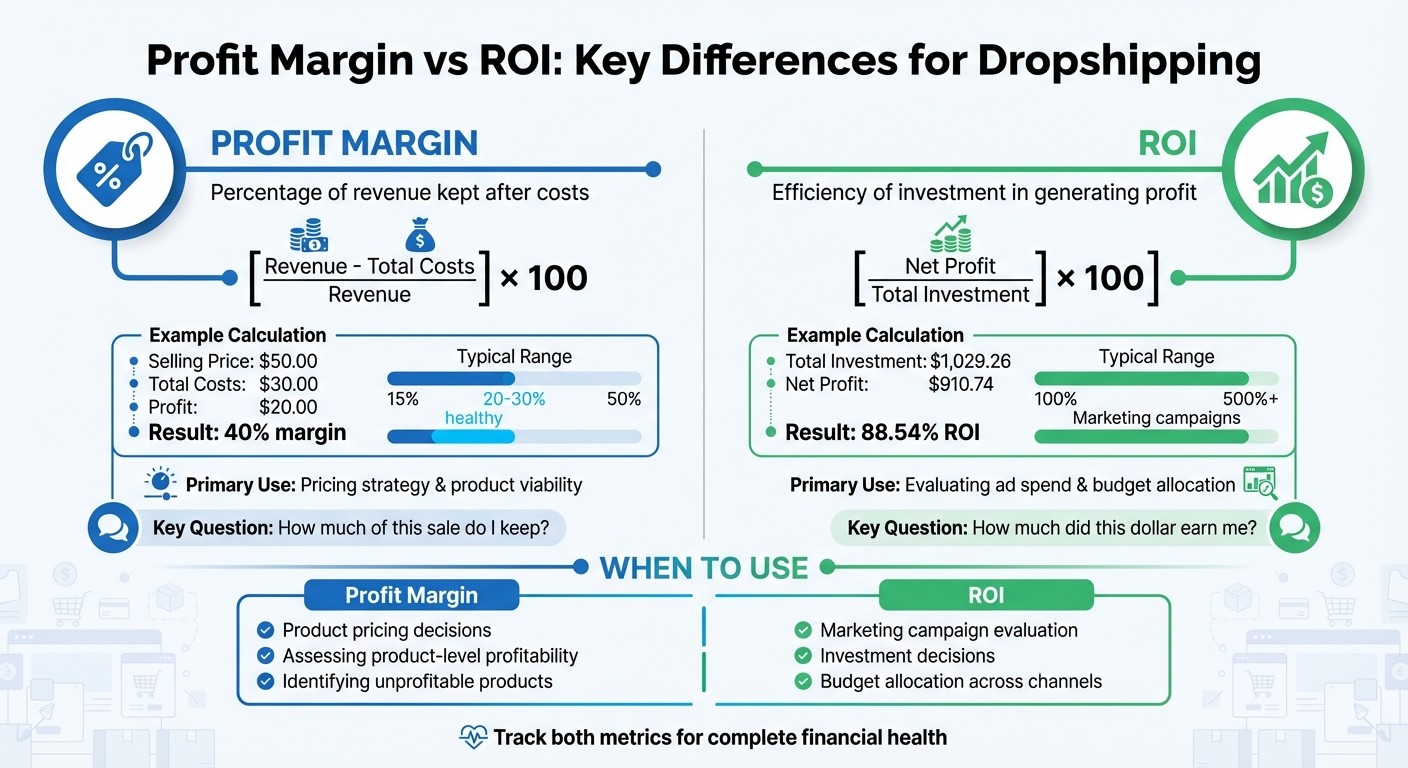
Profit Margin vs ROI: Formula Comparison and Use Cases for Dropshipping
What is Profit Margin?
Definition and Formula
Profit margin measures the percentage of revenue left after covering all costs. In dropshipping, it reflects how much of your selling price turns into profit after deducting product costs, shipping, transaction fees, and other expenses.
Here’s the formula:
Profit Margin (%) = [(Sales Price - Total Cost) / Sales Price] × 100.
For example, if you sell a product for $50.00 and your total costs (including supplier cost, shipping, and fees) are $30.00, your profit is $20.00. Using the formula, ($20.00 / $50.00) × 100 gives you a 40% profit margin.
It’s important to note the difference between gross and net profit margins. Gross profit margin only subtracts the cost of goods sold, while net profit margin accounts for all expenses, giving a clearer picture of overall profitability.
When calculating profit margins, don’t overlook hidden fees. For example, payment processing fees for services like Stripe or PayPal typically run at 2.9% + $0.30 per transaction. Shopify charges fees ranging from 2.4% to 2.9%, depending on your plan. Ignoring these costs can lead to an inaccurate view of your profits. Next, let’s explore typical profit margin ranges in dropshipping to better understand industry standards.
Typical Profit Margin Ranges in Dropshipping
Most dropshipping stores operate with profit margins between 15% and 20%. Margins under 10% are risky because even a single return or unexpected cost can wipe out profits.
A healthier margin usually falls between 20% and 30%. This range allows room to handle returns, test new products, and scale advertising without constantly worrying about breaking even. Margins above 30% are ideal, offering flexibility for ad spending and trying out new marketing strategies.
Your profit margin also impacts how much you can spend on customer acquisition. For instance, products with margins below 30% might need a 7.93× return on ad spend (ROAS) to break even, while those with margins above 80% could break even with just a 1.18× ROAS. This is why experienced dropshippers often aim for at least a 50% gross margin before factoring in advertising costs, ensuring enough room for profitable customer acquisition.
Profit margins can vary widely by niche. For example, pet supplies often see margins of 55–65%, home and kitchen products usually range from 50–60%, and electronics fall between 40–55% due to higher competition and return rates. Fashion, on the other hand, can be tricky, with return rates exceeding 30% in some cases, which can quickly eat into profits.
What is ROI?
Definition and Formula
Return on Investment (ROI) shows how efficiently your investment generates net profit. Unlike profit margin, which measures profit as a percentage of your selling price, ROI compares your net profit to your total investment. This includes all costs like product expenses, fulfillment fees, marketing spend, transaction charges, and platform fees.
Here’s the formula for ROI:
ROI (%) = (Net Profit / Total Investment) × 100.
Let’s break it down with an example: say you spend $1,029.26 in total to operate your store for a day. This amount covers product costs, shipping, ads, and fees. If your revenue for the day is $1,940, your net profit would be $910.74. Plugging this into the formula, ($910.74 / $1,029.26) × 100, gives you an ROI of 88.54%. In simpler terms, for every $1 you invest, you’re earning about 89¢ in net profit.
ROI in Dropshipping: Key Applications
In dropshipping, ROI is more than just a number - it’s a tool for making smarter decisions about investments and operations. A high ROI (above 50%) confirms that your ad campaigns and overall strategy are working well, and it may even indicate your store is ready to scale. On the other hand, an ROI between 10% and 50% suggests there’s room to cut costs or improve conversions. Many dropshippers aim for a 2.5x Return on Ad Spend (ROAS) to maintain steady growth.
While ROAS zeroes in on how effectively you’re spending on ads, ROI offers a bigger picture by including all expenses. This broader view helps you understand your true profitability and pinpoint your break-even point - where your sales fully cover marketing and operational costs.
"Understanding your break-even ROAS is the difference between profitable growth and cash flow destruction. Most ecommerce businesses that fail do so because they prioritized growth over profitability."
Oliver, Author at Digital Ads Calculator
The difference between ROI and Net Profit Margins #entrepreneur #shorts
Formula Differences Between Profit Margin and ROI
The formulas for profit margin and ROI highlight their distinct purposes in business operations, especially for dropshipping.
Profit margin is calculated by dividing net profit by revenue, while ROI uses net profit divided by total investment. This means they address entirely different aspects of your business.
Profit margin focuses on how much of each sale you keep after expenses. For instance, selling a product for $40.00 with a 32.5% profit margin means you keep $13.00 from that sale. On the other hand, ROI measures how efficiently your investment generates profit; if you spend $27.00 to make $13.00 in profit, your ROI is 48.1%. In simpler terms, you earn about 48 cents for every dollar invested.
Another key difference is that profit margin is capped at 100% - you can’t retain more than the full selling price. ROI, however, has no upper limit. Marketing campaigns, for example, often achieve returns ranging from 200% to 500%.
Formula Comparison Table
Feature | Profit Margin | ROI (Return on Investment) |
|---|---|---|
Formula | ((Revenue - Total Costs) / Revenue) × 100 | ((Net Profit / Total Investment) × 100) |
Denominator | Revenue (Selling Price) | Total Cost (Investment) |
Key Question | "How much of this sale do I keep?" | "How much did this dollar earn me?" |
Example in Dropshipping | Selling Price: $34.99, Costs: $17.96, Profit: $17.03 → 48.7% | Investment: $17.96, Profit: $17.03 → 94.8% |
Typical Range | 15% – 50% | 100% – 500%+ (for marketing) |
Primary Use | Pricing strategy and product viability | Evaluating ad spend and budget allocation |
Profit margin is especially helpful for pricing decisions and assessing whether a product is worth selling. It ensures there’s enough profit left after covering costs like product expenses, shipping, and transaction fees (e.g., 2.9% + $0.30 per sale). ROI, on the other hand, helps you decide where to allocate your advertising budget by showing which channels deliver the highest profit per dollar spent.
Understanding these differences allows you to decide whether to focus on adjusting prices or optimizing investments to grow your business effectively.
When to Use Profit Margin vs ROI
Choosing between profit margin and ROI depends on what you're trying to evaluate. Profit margin works best for pricing decisions and analyzing individual products, while ROI is more effective for assessing the success of your investments, particularly in marketing.
Using Profit Margin for Pricing and Product Analysis
Profit margin is essential when deciding which products to sell or determining your pricing strategy. A solid margin not only ensures profitability but also provides a buffer against unexpected costs like rising shipping rates or advertising expenses. For instance, a 50% margin on a $40.00 product results in a $20.00 profit, whereas a 20% margin only brings in $8.00.
Keeping a close eye on your costs is equally important. Regularly auditing your margins - especially when suppliers adjust prices or shipping costs fluctuate - can help you identify problems early. This prevents you from making sales that fail to generate a profit. Leah Tran, Content Executive at TrueProfit, emphasizes this point:
"Margin helps you decide what's worth selling, while profit tells you whether your business is actually working."
For Shopify dropshipping stores, profit margins typically range between 20% and 50% when pricing is done effectively. Margins below 10%, however, leave little room to adapt to market shifts. Before investing in advertising, ensure your product has a strong gross margin to avoid scaling a product that ends up losing money.
While profit margin helps fine-tune product pricing, ROI takes a broader approach by guiding investment decisions.
Using ROI for Investment and Campaign Decisions
ROI moves beyond individual product analysis to evaluate the overall performance of your investments. It’s especially useful for identifying which marketing channels - like Facebook ads, Google campaigns, or influencer collaborations - deliver the best return per dollar spent. In ecommerce, successful digital marketing campaigns often aim for an ROI between 200% and 500%.
ROI also helps you weigh the potential of various investment opportunities, such as new software tools, bulk inventory purchases, or product launches. For small businesses, an overall ROI between 15% and 30% is a common target to account for operational risks.
A practical way to use ROI is by calculating your break-even ROAS (Return on Ad Spend) based on your profit margin. This tells you the minimum marketing performance needed to avoid losses. By allocating ad budgets to products with higher net profit margins, you ensure that every dollar spent is working harder for you. As Shopify Staff explains:
"ROI isn't just a financial metric - it's a feedback loop for smarter decisions."
Together, profit margin and ROI provide a comprehensive view of your dropshipping strategy, balancing product-level profitability with overall investment efficiency.
Conclusion
Profit margin and ROI are like two sides of the same coin when it comes to assessing your dropshipping store's performance. While profit margin measures how well your pricing strategy turns sales into earnings, ROI evaluates how effectively your investments - especially in marketing - contribute to growth. Together, they offer a fuller picture of your store's financial health.
Tracking both metrics is crucial to avoid missing key issues like cash flow challenges or pricing inefficiencies. As Leah Tran, Content Executive at TrueProfit, puts it:
"Relying solely on profit may overlook pricing and cost inefficiencies, while focusing only on margin may ignore cash flow constraints."
In 2026, the average net profit margin for dropshipping stores was 18.3%, with a gross margin of 67.4%. The gap between these figures highlights costs like ad spend, transaction fees, and other hidden expenses. Successful stores often aim for net margins between 20% and 30%, while digital marketing strategies typically target an ROI of 200% to 500%. These benchmarks can guide your decisions on pricing and marketing strategies.
With supplier costs and ad prices constantly shifting, manually tracking these metrics can be a headache. BuildMyStores offers automated dashboards that sync real-time data from your Shopify store, suppliers, and ad platforms, giving you instant insights into your net profit. Plus, their free AI-built stores are ready to launch in minutes.
FAQs
Which costs should I include in profit margin?
To figure out your profit margin, you need to account for all the costs directly related to each sale. This includes the product's purchase price, shipping charges, transaction fees, and advertising costs. These variable expenses provide a clear picture of what each sale truly costs, ensuring your profit margin calculations are accurate. Ignoring these can lead to inaccurate assessments of your profitability.
How do I calculate ROI for a single product?
To figure out the ROI for a single product, start by subtracting all related costs - like the product itself, shipping, advertising, and fees - from the revenue. This gives you the net profit. Next, divide that net profit by the total investment, then multiply by 100 to express it as a percentage.
For instance, if your net profit is $100 and your total investment is $50, the ROI works out to 200%.
What is break-even ROAS and how do I find it?
Break-even ROAS is the bare minimum your business needs to earn from ad spend to cover all costs without losing money. The formula is straightforward: divide 1 by your profit margin (as a decimal).
Here’s an example: If your profit margin is 25% (or 0.25), you’d calculate your break-even ROAS like this:
1 ÷ 0.25 = 4
In this case, a ROAS of 4 means for every dollar spent on ads, you need to generate $4 in revenue just to break even. Anything above that starts contributing to profit.
Related Blog Posts
Profit margin and ROI (Return on Investment) are two critical metrics for running a successful dropshipping business. Here's why they matter:
Profit margin shows how much of each sale you keep after covering costs like product expenses, shipping, and transaction fees. It helps you price products effectively and avoid selling at a loss.
ROI measures how efficiently your investments (e.g., marketing campaigns, tools) generate profit. It helps you decide where to spend your money for the best returns.
Key Points:
Profit Margin Formula:
[(Sales Price - Total Cost) / Sales Price] × 100
Example: Selling a $50 product with $30 in costs gives a 40% margin.
ROI Formula:
[(Net Profit / Total Investment) × 100]
Example: Spending $1,029 to earn $910.74 results in an 88.54% ROI.
Typical Ranges:
Dropshipping profit margins: 15%–50% (20–30% is healthy).
Marketing campaign ROI: 200%–500%.
Quick Comparison:
Feature | Profit Margin | ROI (Return on Investment) |
|---|---|---|
Formula | [(Revenue - Total Costs) / Revenue] × 100 | [(Net Profit / Total Investment) × 100] |
Focus | Pricing and product profitability | Investment efficiency |
Typical Range | 15%–50% | 100%–500%+ |
Tracking both metrics ensures smarter decisions on pricing, scaling, and marketing. Profit margin helps you assess product-level profitability, while ROI evaluates the effectiveness of your investments. Together, they provide a clear picture of your financial health.
Profit Margin vs ROI: Formula Comparison and Use Cases for Dropshipping
What is Profit Margin?
Definition and Formula
Profit margin measures the percentage of revenue left after covering all costs. In dropshipping, it reflects how much of your selling price turns into profit after deducting product costs, shipping, transaction fees, and other expenses.
Here’s the formula:
Profit Margin (%) = [(Sales Price - Total Cost) / Sales Price] × 100.
For example, if you sell a product for $50.00 and your total costs (including supplier cost, shipping, and fees) are $30.00, your profit is $20.00. Using the formula, ($20.00 / $50.00) × 100 gives you a 40% profit margin.
It’s important to note the difference between gross and net profit margins. Gross profit margin only subtracts the cost of goods sold, while net profit margin accounts for all expenses, giving a clearer picture of overall profitability.
When calculating profit margins, don’t overlook hidden fees. For example, payment processing fees for services like Stripe or PayPal typically run at 2.9% + $0.30 per transaction. Shopify charges fees ranging from 2.4% to 2.9%, depending on your plan. Ignoring these costs can lead to an inaccurate view of your profits. Next, let’s explore typical profit margin ranges in dropshipping to better understand industry standards.
Typical Profit Margin Ranges in Dropshipping
Most dropshipping stores operate with profit margins between 15% and 20%. Margins under 10% are risky because even a single return or unexpected cost can wipe out profits.
A healthier margin usually falls between 20% and 30%. This range allows room to handle returns, test new products, and scale advertising without constantly worrying about breaking even. Margins above 30% are ideal, offering flexibility for ad spending and trying out new marketing strategies.
Your profit margin also impacts how much you can spend on customer acquisition. For instance, products with margins below 30% might need a 7.93× return on ad spend (ROAS) to break even, while those with margins above 80% could break even with just a 1.18× ROAS. This is why experienced dropshippers often aim for at least a 50% gross margin before factoring in advertising costs, ensuring enough room for profitable customer acquisition.
Profit margins can vary widely by niche. For example, pet supplies often see margins of 55–65%, home and kitchen products usually range from 50–60%, and electronics fall between 40–55% due to higher competition and return rates. Fashion, on the other hand, can be tricky, with return rates exceeding 30% in some cases, which can quickly eat into profits.
What is ROI?
Definition and Formula
Return on Investment (ROI) shows how efficiently your investment generates net profit. Unlike profit margin, which measures profit as a percentage of your selling price, ROI compares your net profit to your total investment. This includes all costs like product expenses, fulfillment fees, marketing spend, transaction charges, and platform fees.
Here’s the formula for ROI:
ROI (%) = (Net Profit / Total Investment) × 100.
Let’s break it down with an example: say you spend $1,029.26 in total to operate your store for a day. This amount covers product costs, shipping, ads, and fees. If your revenue for the day is $1,940, your net profit would be $910.74. Plugging this into the formula, ($910.74 / $1,029.26) × 100, gives you an ROI of 88.54%. In simpler terms, for every $1 you invest, you’re earning about 89¢ in net profit.
ROI in Dropshipping: Key Applications
In dropshipping, ROI is more than just a number - it’s a tool for making smarter decisions about investments and operations. A high ROI (above 50%) confirms that your ad campaigns and overall strategy are working well, and it may even indicate your store is ready to scale. On the other hand, an ROI between 10% and 50% suggests there’s room to cut costs or improve conversions. Many dropshippers aim for a 2.5x Return on Ad Spend (ROAS) to maintain steady growth.
While ROAS zeroes in on how effectively you’re spending on ads, ROI offers a bigger picture by including all expenses. This broader view helps you understand your true profitability and pinpoint your break-even point - where your sales fully cover marketing and operational costs.
"Understanding your break-even ROAS is the difference between profitable growth and cash flow destruction. Most ecommerce businesses that fail do so because they prioritized growth over profitability."
Oliver, Author at Digital Ads Calculator
The difference between ROI and Net Profit Margins #entrepreneur #shorts
Formula Differences Between Profit Margin and ROI
The formulas for profit margin and ROI highlight their distinct purposes in business operations, especially for dropshipping.
Profit margin is calculated by dividing net profit by revenue, while ROI uses net profit divided by total investment. This means they address entirely different aspects of your business.
Profit margin focuses on how much of each sale you keep after expenses. For instance, selling a product for $40.00 with a 32.5% profit margin means you keep $13.00 from that sale. On the other hand, ROI measures how efficiently your investment generates profit; if you spend $27.00 to make $13.00 in profit, your ROI is 48.1%. In simpler terms, you earn about 48 cents for every dollar invested.
Another key difference is that profit margin is capped at 100% - you can’t retain more than the full selling price. ROI, however, has no upper limit. Marketing campaigns, for example, often achieve returns ranging from 200% to 500%.
Formula Comparison Table
Feature | Profit Margin | ROI (Return on Investment) |
|---|---|---|
Formula | ((Revenue - Total Costs) / Revenue) × 100 | ((Net Profit / Total Investment) × 100) |
Denominator | Revenue (Selling Price) | Total Cost (Investment) |
Key Question | "How much of this sale do I keep?" | "How much did this dollar earn me?" |
Example in Dropshipping | Selling Price: $34.99, Costs: $17.96, Profit: $17.03 → 48.7% | Investment: $17.96, Profit: $17.03 → 94.8% |
Typical Range | 15% – 50% | 100% – 500%+ (for marketing) |
Primary Use | Pricing strategy and product viability | Evaluating ad spend and budget allocation |
Profit margin is especially helpful for pricing decisions and assessing whether a product is worth selling. It ensures there’s enough profit left after covering costs like product expenses, shipping, and transaction fees (e.g., 2.9% + $0.30 per sale). ROI, on the other hand, helps you decide where to allocate your advertising budget by showing which channels deliver the highest profit per dollar spent.
Understanding these differences allows you to decide whether to focus on adjusting prices or optimizing investments to grow your business effectively.
When to Use Profit Margin vs ROI
Choosing between profit margin and ROI depends on what you're trying to evaluate. Profit margin works best for pricing decisions and analyzing individual products, while ROI is more effective for assessing the success of your investments, particularly in marketing.
Using Profit Margin for Pricing and Product Analysis
Profit margin is essential when deciding which products to sell or determining your pricing strategy. A solid margin not only ensures profitability but also provides a buffer against unexpected costs like rising shipping rates or advertising expenses. For instance, a 50% margin on a $40.00 product results in a $20.00 profit, whereas a 20% margin only brings in $8.00.
Keeping a close eye on your costs is equally important. Regularly auditing your margins - especially when suppliers adjust prices or shipping costs fluctuate - can help you identify problems early. This prevents you from making sales that fail to generate a profit. Leah Tran, Content Executive at TrueProfit, emphasizes this point:
"Margin helps you decide what's worth selling, while profit tells you whether your business is actually working."
For Shopify dropshipping stores, profit margins typically range between 20% and 50% when pricing is done effectively. Margins below 10%, however, leave little room to adapt to market shifts. Before investing in advertising, ensure your product has a strong gross margin to avoid scaling a product that ends up losing money.
While profit margin helps fine-tune product pricing, ROI takes a broader approach by guiding investment decisions.
Using ROI for Investment and Campaign Decisions
ROI moves beyond individual product analysis to evaluate the overall performance of your investments. It’s especially useful for identifying which marketing channels - like Facebook ads, Google campaigns, or influencer collaborations - deliver the best return per dollar spent. In ecommerce, successful digital marketing campaigns often aim for an ROI between 200% and 500%.
ROI also helps you weigh the potential of various investment opportunities, such as new software tools, bulk inventory purchases, or product launches. For small businesses, an overall ROI between 15% and 30% is a common target to account for operational risks.
A practical way to use ROI is by calculating your break-even ROAS (Return on Ad Spend) based on your profit margin. This tells you the minimum marketing performance needed to avoid losses. By allocating ad budgets to products with higher net profit margins, you ensure that every dollar spent is working harder for you. As Shopify Staff explains:
"ROI isn't just a financial metric - it's a feedback loop for smarter decisions."
Together, profit margin and ROI provide a comprehensive view of your dropshipping strategy, balancing product-level profitability with overall investment efficiency.
Conclusion
Profit margin and ROI are like two sides of the same coin when it comes to assessing your dropshipping store's performance. While profit margin measures how well your pricing strategy turns sales into earnings, ROI evaluates how effectively your investments - especially in marketing - contribute to growth. Together, they offer a fuller picture of your store's financial health.
Tracking both metrics is crucial to avoid missing key issues like cash flow challenges or pricing inefficiencies. As Leah Tran, Content Executive at TrueProfit, puts it:
"Relying solely on profit may overlook pricing and cost inefficiencies, while focusing only on margin may ignore cash flow constraints."
In 2026, the average net profit margin for dropshipping stores was 18.3%, with a gross margin of 67.4%. The gap between these figures highlights costs like ad spend, transaction fees, and other hidden expenses. Successful stores often aim for net margins between 20% and 30%, while digital marketing strategies typically target an ROI of 200% to 500%. These benchmarks can guide your decisions on pricing and marketing strategies.
With supplier costs and ad prices constantly shifting, manually tracking these metrics can be a headache. BuildMyStores offers automated dashboards that sync real-time data from your Shopify store, suppliers, and ad platforms, giving you instant insights into your net profit. Plus, their free AI-built stores are ready to launch in minutes.
FAQs
Which costs should I include in profit margin?
To figure out your profit margin, you need to account for all the costs directly related to each sale. This includes the product's purchase price, shipping charges, transaction fees, and advertising costs. These variable expenses provide a clear picture of what each sale truly costs, ensuring your profit margin calculations are accurate. Ignoring these can lead to inaccurate assessments of your profitability.
How do I calculate ROI for a single product?
To figure out the ROI for a single product, start by subtracting all related costs - like the product itself, shipping, advertising, and fees - from the revenue. This gives you the net profit. Next, divide that net profit by the total investment, then multiply by 100 to express it as a percentage.
For instance, if your net profit is $100 and your total investment is $50, the ROI works out to 200%.
What is break-even ROAS and how do I find it?
Break-even ROAS is the bare minimum your business needs to earn from ad spend to cover all costs without losing money. The formula is straightforward: divide 1 by your profit margin (as a decimal).
Here’s an example: If your profit margin is 25% (or 0.25), you’d calculate your break-even ROAS like this:
1 ÷ 0.25 = 4
In this case, a ROAS of 4 means for every dollar spent on ads, you need to generate $4 in revenue just to break even. Anything above that starts contributing to profit.
Related Blog Posts
Get your store!
© 2025 BuildMyStores
© 2025 BuildMyStores