🎉 Start Shopify’s $1 Plan and We’ll pay you up to $3,600 just for starting! 💸 — Limited Time
Get Limited Time Offer 💰
Offer Details — Rewards require completing eligible third-party offers. Reward amounts vary from $30 to $3,600. Terms and eligibility restrictions apply.
🎉 Start Shopify’s $1 Plan and We’ll pay you up to $3,600 just for starting! 💸 — Limited Time
Get Limited Time Offer 💰
Offer Details — Rewards require completing eligible third-party offers. Reward amounts vary from $30 to $3,600. Terms and eligibility restrictions apply.
🎉 Start Shopify’s $1 Plan and We’ll pay you up to $3,600 just for starting! 💸 — Limited Time
Get Limited Time Offer 💰
Offer Details — Rewards require completing eligible third-party offers. Reward amounts vary from $30 to $3,600. Terms and eligibility restrictions apply.
Ecommerce Strategies
How AI Improves Dropshipping Profit Margins
How AI Improves Dropshipping Profit Margins

AI is transforming dropshipping by helping businesses monitor and optimize their profit margins in real time. Many dropshippers struggle with hidden costs like ad spend, shipping fees, and payment processing charges, which can eat up 30% or more of their revenue. AI tools solve this by consolidating fragmented data, automating profit tracking, and identifying inefficiencies, allowing store owners to make smarter decisions.
Key Takeaways:
Hidden Costs: Ad spend (15–30%), shipping fees (8–15%), and payment processing (~3%) can erode profits.
AI Solutions: Tools like Shopify Sidekick and Triple Whale calculate real-time profit margins, flag unprofitable products, and predict demand up to 90 days in advance.
Dynamic Pricing: AI adjusts prices automatically based on competitor data and demand, boosting revenue by 15–25%.
Ad Spend Control: Shifting from ROAS to POAS ensures ad budgets drive actual profit, not just revenue.
Product Selection: AI evaluates products for margin potential, avoiding low-profit or high-risk items.
By integrating AI tools and focusing on profit-driven metrics, dropshippers can reduce inefficiencies and achieve higher margins, even in a competitive market.
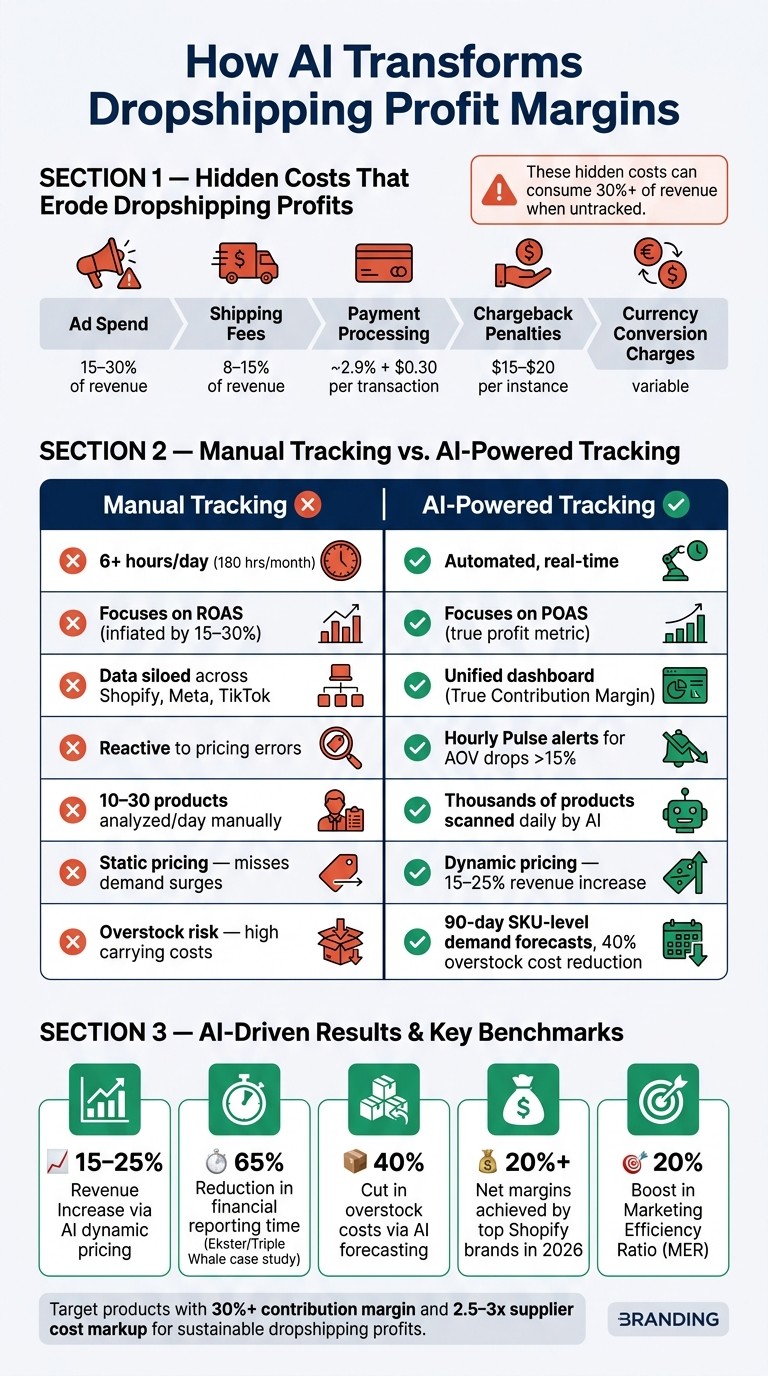
AI vs. Manual Dropshipping: Profit Margin Impact at a Glance
Key Challenges That Hurt Dropshipping Profit Margins
Dropshipping operates with tight profit margins, typically ranging from 15% to 45%, compared to the 40% to 80% margins seen in traditional retail. This slimmer margin means that even small errors or overlooked costs can have a significant impact on profitability.
Hidden Costs That Erode Profits
Dropshipping is riddled with hidden costs that can quietly chip away at your bottom line. These include:
Ad spend: Often accounting for 15%–30% of revenue.
Shipping fees: Typically 8%–15%.
Payment processing fees: Usually 2.9% + $0.30 per transaction.
Currency conversion charges: A less obvious but frequent cost.
Chargeback penalties: Ranging from $15 to $20 per instance.
One of the biggest challenges is that these costs are scattered across multiple platforms. Sales data might be in Shopify, advertising expenses in Meta or TikTok, and financial records in separate accounting tools. This fragmented tracking makes it difficult to get a clear picture of your actual profit margins. Without centralized data, it's easy to lose sight of the true financial health of your business.
These hidden expenses become even more problematic when combined with poor product choices or pricing strategies.
Poor Product Selection and Pricing Strategies
Choosing the wrong products can quickly drain profits. Products with gross margins below 30% leave little room to cover advertising costs or absorb returns. For instance, a single product return can erase the profit from as many as five successful sales. Yet, many sellers focus only on metrics like high revenue or return on ad spend (ROAS), overlooking critical factors like shipping fees, return rates, or payment processing costs.
Static pricing strategies also pose a risk. Fixed prices can lead to underpricing when demand surges or losing sales when competitors lower their prices. Additionally, return rates - while averaging between 5% and 10% for most niches - can spike to as high as 15% to 25% in categories like apparel. These variables make pricing decisions a constant balancing act.
The Drawbacks of Manual Profit Tracking
Operational inefficiencies, like manual tracking, further strain already tight margins. Manually updating spreadsheets to monitor supplier costs or shipping rates is both time-consuming and error-prone. Prices and fees can change overnight, and by the time adjustments are caught, you may have already sold products at a loss.
Another issue with manual tracking is the focus on vanity metrics like ROAS, which fail to account for critical elements such as the cost of goods sold (COGS) or shipping expenses.
"The danger is not in the AI making a mistake, but in the merchant ignoring the hidden costs that the AI has already identified." - Logan Brown, Triple Whale
On top of this, manual tracking can consume over six hours a day - adding up to around 180 hours a month. That’s valuable time spent reacting to problems instead of optimizing your business. In an industry where quick decisions are crucial, delays caused by manual processes can be devastating.
How AI Improves Profit Margin Analysis
AI is changing the game for profit margin analysis, tackling the hurdles of fragmented data and manual tracking head-on. By consolidating data from multiple sources, AI provides a comprehensive view of the True Contribution Margin - calculated as revenue minus COGS, shipping, fees, and ad spend - all in real time.
Real-Time Margin Analysis with AI
Platforms like Luca AI and Triple Whale connect seamlessly with Shopify, ad platforms, and logistics providers to deliver real-time net profit insights down to the SKU level. This shifts the focus away from high-level metrics like ROAS (Return on Ad Spend) to POAS (Profit on Ad Spend), which paints a more accurate picture of profitability after accounting for all expenses.
Ad platforms often inflate conversion data by 15% to 30%, thanks to privacy rules and modeled attribution. AI tools that use first-party tracking pixels help close this accuracy gap, giving you reliable metrics for smarter decisions.
"If your AI report doesn't automatically subtract COGS, shipping, and returns in real-time, it isn't a report - it's a wish list." - Stormy AI
Beyond giving you a snapshot of current margins, AI also helps forecast future trends.
Forecasting Future Margins with AI
AI uses historical data and seasonal patterns to predict future margins, allowing businesses to adjust strategies ahead of time. For instance, Inventory Planner by Sage leverages the Facebook Prophet model to create 90-day demand forecasts at the SKU level. This kind of forecasting can cut overstock costs by as much as 40%.
While forecasting prepares you for future challenges, AI's continuous monitoring ensures you're catching issues as they arise.
Spotting Profit Drains Automatically
AI tools don’t just analyze - they actively watch for hidden cost leaks. Shopify Sidekick, for example, performs SKU-level audits to identify products that appear profitable but lose money when returns, shipping surcharges, and ad costs are factored in. Some AI systems even run hourly "Pulse" checks, sending alerts when metrics like Average Order Value drop significantly - such as more than 15% below the four-week average - and cross-referencing these changes with ad performance data.
A real-world example? In 2026, DTC brand Ekster used Triple Whale's Moby AI agents to streamline financial reporting, cutting the time spent by 65% and boosting its Marketing Efficiency Ratio (MER) by 20%. This demonstrates how AI goes beyond dashboards, actively steering businesses toward better profitability.
AI Strategies to Grow Dropshipping Profits
Once you've set up real-time margin analysis, the next step is using AI to supercharge your dropshipping profits. This involves smarter product selection, dynamic pricing strategies, and cutting down on wasted ad spend.
Using AI to Pick High-Margin Products
Manual product research has its limits - it’s slow and often misses opportunities. A typical manual process might analyze 10–30 products a day from just a couple of sources. AI tools, on the other hand, can scan thousands of products daily across multiple data sources like TikTok engagement trends, Google search volumes, marketplace velocity, and competitor gaps.
What makes AI especially effective is its ability to calculate margin potential. It automatically accounts for all variable costs, giving you a true contribution margin before ad spend. For dropshipping success in 2026, focus on products with a contribution margin of 30% or higher and a markup of 2.5–3x the supplier cost.
AI also helps you avoid costly mistakes. It evaluates products for risks like seasonal dependency, unstable suppliers, or intellectual property issues. This means you're not just finding profitable products - you’re steering clear of potential pitfalls.
But product selection is just the start. AI-powered dynamic pricing takes profit optimization to the next level.
Dynamic Pricing Powered by AI
In a fast-moving market, static pricing just doesn’t cut it. Tools like Prisync use AI to adjust prices in real time based on competitor data.
The big win here is protecting your margins. You can set minimum margin rules, ensuring your prices never drop below a profitable level. Plus, when competitors run out of stock, the system can automatically raise your prices to maximize profits. Businesses using AI-driven dynamic pricing report revenue increases of 15–25% compared to manual pricing methods.
"Dynamic pricing isn't about being the cheapest; it's about being the most strategically priced at every single second of the day." - Prisync
Cutting Ad Waste with AI Budget Allocation
Ad spend is one of the biggest threats to dropshipping margins, often eating up 15–30% of total revenue in 2026. Traditional ad management focuses on ROAS (Return on Ad Spend), which ignores key factors like shipping costs and return rates. AI shifts the focus to POAS (Profit on Ad Spend), ensuring every dollar spent contributes to your actual profit, not just revenue.
Here’s one simple yet effective tip: use AI to pause ads on platforms like Google or TikTok when a product’s stock is predicted to run out within seven days. This prevents wasting money on traffic for items you can’t deliver. Pair that with AI tools that quickly generate hundreds of ad variations, allowing you to identify top-performing creatives in days instead of weeks. The result? Lower ad spend and higher conversion rates.
How to Use AI and BuildMyStores for a Profitable Dropshipping Business
Blending AI-powered tools for pricing, ad optimization, and unified data tracking creates a reliable system for generating profits. The next step? Establish a unified margin tracking workflow to anchor your AI-driven strategies.
Building a Margin Tracking Workflow
The first hurdle is eliminating data silos. Dropshippers often deal with a 15–30% reporting gap because their data is scattered across Shopify, ad platforms, and 3PLs. This makes profit-related decisions less dependable.
To fix this, consolidate all your data onto a single platform. Tools like Luca AI or Stormy AI can automatically pull data from your Shopify sales, shipping costs, payment fees, and ad spend. These platforms calculate your True Contribution Margin in real-time, giving you a clear picture of your profitability. Set up hourly alerts to monitor metrics like average order value (AOV). For example, if your AOV drops by more than 15%, you’ll know immediately and can act fast.
"If your AI report doesn't automatically subtract COGS, shipping, and returns in real-time, it isn't a report - it's a wish list." - Stormy AI
Using first-party tracking pixels ensures your AI tools receive accurate, clean data, which is critical for precise margin calculations across every SKU.
Once you’ve built this solid data infrastructure, you can fully unleash AI to optimize profits.
How BuildMyStores Supports Profit Optimization
A margin-focused approach only works if your store is designed to convert visitors into buyers. BuildMyStores provides a free AI-built Shopify store with themes optimized for conversions. This reduces customer acquisition costs and protects your margins. The platform simplifies store setup and integrates seamlessly with AI tools to continually improve your bottom line.
With 100% ownership and full customization rights, you can integrate any AI tool you need. Whether it’s TrueProfit for profit analytics, AutoDS for automated fulfillment, or Prisync for dynamic pricing, the platform supports your goals without taking a cut of your revenue. Plus, the five-minute setup allows you to quickly move from finding products to live testing - crucial for staying ahead in a fast-paced market.
Running a Continuous Margin Improvement Cycle
Profit optimization isn’t a one-time task - it’s an ongoing process. Start by using AI tools like Shopify Sidekick to conduct weekly margin-drainer audits. Identify top-selling SKUs with low net profit and decide whether to reprice, replace, or phase them out. AI forecasting can also help you cut overstock costs by as much as 40%.
Shift your primary marketing metric from ROAS (Return on Ad Spend) to POAS (Profit on Ad Spend). This ensures your campaigns focus on driving actual profit rather than just revenue. Over time, this cycle - auditing products, fine-tuning pricing, optimizing ads, and renegotiating supplier costs based on AI insights - builds stronger margins. By 2026, top-performing Shopify brands are expected to achieve net margins exceeding 20% by following this AI-driven model.
"The danger is not in the AI making a mistake, but in the merchant ignoring the hidden costs that the AI has already identified." - Logan Brown, Triple Whale
Conclusion: Why AI Matters for Dropshipping Margins
Dropshipping hasn’t typically been associated with high margins, but AI is helping to change that. By replacing manual processes with real-time data and automated, data-driven strategies, merchants now have a clear opportunity to improve profitability.
Leading Shopify brands in 2026 are reporting net margins exceeding 20%, thanks to smarter inventory management, enforcing pricing floors, and shifting their focus from ROAS to POAS. These improvements can be the difference between merely staying afloat and achieving real growth. (You can even earn by referring others to our affiliate program for free AI stores.)
"2026 is the 'year of the builders,' where AI agents handle operational complexity so merchants can focus on brand strategy." - Harley Finkelstein, President, Shopify
With projections showing the AI-powered e-commerce market hitting $22.6 billion by 2032, merchants who adopt AI tools today are positioning themselves to stay ahead as the industry continues to evolve.
FAQs
What’s the fastest way to calculate true profit per SKU?
To figure out the true profit for each SKU quickly, you need to account for all associated costs. This includes things like product costs, shipping fees, payment processing charges, and ad spend. Using AI tools can make this process much easier. They can automate the calculations, helping you pinpoint and adjust profit margins while saving time and ensuring accuracy.
How do I switch from ROAS to POAS without breaking my ad strategy?
To shift from ROAS to POAS without throwing off your ad strategy, start by focusing on profit-based metrics. Leverage AI tools to automate the analysis of profit margins and keep an eye on real-time profit data. From there, adjust your campaigns to emphasize profit margins rather than just revenue. Use these profit metrics to fine-tune your efforts, keeping your strategy effective while steering it toward long-term profitability.
What rules should I set for AI pricing to avoid losing money?
To keep your profits on track, it's important to establish clear pricing guidelines when using AI tools. Here are some key steps to consider:
Set minimum and maximum price limits: This ensures your products aren't undervalued or overpriced, protecting both your brand and bottom line.
Prioritize profit margins over sales volume: A focus on margins helps maintain sustainable pricing strategies instead of chasing short-term gains.
Monitor and adjust AI outputs regularly: Markets change, and so should your pricing. Keeping a close eye on AI-generated prices helps you stay competitive and avoid costly mistakes.
Implement safeguards: Prevent extreme price fluctuations or potential legal complications by setting boundaries for your AI system.
These measures can help you fine-tune pricing strategies while keeping your profit margins steady.
Related Blog Posts
AI is transforming dropshipping by helping businesses monitor and optimize their profit margins in real time. Many dropshippers struggle with hidden costs like ad spend, shipping fees, and payment processing charges, which can eat up 30% or more of their revenue. AI tools solve this by consolidating fragmented data, automating profit tracking, and identifying inefficiencies, allowing store owners to make smarter decisions.
Key Takeaways:
Hidden Costs: Ad spend (15–30%), shipping fees (8–15%), and payment processing (~3%) can erode profits.
AI Solutions: Tools like Shopify Sidekick and Triple Whale calculate real-time profit margins, flag unprofitable products, and predict demand up to 90 days in advance.
Dynamic Pricing: AI adjusts prices automatically based on competitor data and demand, boosting revenue by 15–25%.
Ad Spend Control: Shifting from ROAS to POAS ensures ad budgets drive actual profit, not just revenue.
Product Selection: AI evaluates products for margin potential, avoiding low-profit or high-risk items.
By integrating AI tools and focusing on profit-driven metrics, dropshippers can reduce inefficiencies and achieve higher margins, even in a competitive market.
AI vs. Manual Dropshipping: Profit Margin Impact at a Glance
Key Challenges That Hurt Dropshipping Profit Margins
Dropshipping operates with tight profit margins, typically ranging from 15% to 45%, compared to the 40% to 80% margins seen in traditional retail. This slimmer margin means that even small errors or overlooked costs can have a significant impact on profitability.
Hidden Costs That Erode Profits
Dropshipping is riddled with hidden costs that can quietly chip away at your bottom line. These include:
Ad spend: Often accounting for 15%–30% of revenue.
Shipping fees: Typically 8%–15%.
Payment processing fees: Usually 2.9% + $0.30 per transaction.
Currency conversion charges: A less obvious but frequent cost.
Chargeback penalties: Ranging from $15 to $20 per instance.
One of the biggest challenges is that these costs are scattered across multiple platforms. Sales data might be in Shopify, advertising expenses in Meta or TikTok, and financial records in separate accounting tools. This fragmented tracking makes it difficult to get a clear picture of your actual profit margins. Without centralized data, it's easy to lose sight of the true financial health of your business.
These hidden expenses become even more problematic when combined with poor product choices or pricing strategies.
Poor Product Selection and Pricing Strategies
Choosing the wrong products can quickly drain profits. Products with gross margins below 30% leave little room to cover advertising costs or absorb returns. For instance, a single product return can erase the profit from as many as five successful sales. Yet, many sellers focus only on metrics like high revenue or return on ad spend (ROAS), overlooking critical factors like shipping fees, return rates, or payment processing costs.
Static pricing strategies also pose a risk. Fixed prices can lead to underpricing when demand surges or losing sales when competitors lower their prices. Additionally, return rates - while averaging between 5% and 10% for most niches - can spike to as high as 15% to 25% in categories like apparel. These variables make pricing decisions a constant balancing act.
The Drawbacks of Manual Profit Tracking
Operational inefficiencies, like manual tracking, further strain already tight margins. Manually updating spreadsheets to monitor supplier costs or shipping rates is both time-consuming and error-prone. Prices and fees can change overnight, and by the time adjustments are caught, you may have already sold products at a loss.
Another issue with manual tracking is the focus on vanity metrics like ROAS, which fail to account for critical elements such as the cost of goods sold (COGS) or shipping expenses.
"The danger is not in the AI making a mistake, but in the merchant ignoring the hidden costs that the AI has already identified." - Logan Brown, Triple Whale
On top of this, manual tracking can consume over six hours a day - adding up to around 180 hours a month. That’s valuable time spent reacting to problems instead of optimizing your business. In an industry where quick decisions are crucial, delays caused by manual processes can be devastating.
How AI Improves Profit Margin Analysis
AI is changing the game for profit margin analysis, tackling the hurdles of fragmented data and manual tracking head-on. By consolidating data from multiple sources, AI provides a comprehensive view of the True Contribution Margin - calculated as revenue minus COGS, shipping, fees, and ad spend - all in real time.
Real-Time Margin Analysis with AI
Platforms like Luca AI and Triple Whale connect seamlessly with Shopify, ad platforms, and logistics providers to deliver real-time net profit insights down to the SKU level. This shifts the focus away from high-level metrics like ROAS (Return on Ad Spend) to POAS (Profit on Ad Spend), which paints a more accurate picture of profitability after accounting for all expenses.
Ad platforms often inflate conversion data by 15% to 30%, thanks to privacy rules and modeled attribution. AI tools that use first-party tracking pixels help close this accuracy gap, giving you reliable metrics for smarter decisions.
"If your AI report doesn't automatically subtract COGS, shipping, and returns in real-time, it isn't a report - it's a wish list." - Stormy AI
Beyond giving you a snapshot of current margins, AI also helps forecast future trends.
Forecasting Future Margins with AI
AI uses historical data and seasonal patterns to predict future margins, allowing businesses to adjust strategies ahead of time. For instance, Inventory Planner by Sage leverages the Facebook Prophet model to create 90-day demand forecasts at the SKU level. This kind of forecasting can cut overstock costs by as much as 40%.
While forecasting prepares you for future challenges, AI's continuous monitoring ensures you're catching issues as they arise.
Spotting Profit Drains Automatically
AI tools don’t just analyze - they actively watch for hidden cost leaks. Shopify Sidekick, for example, performs SKU-level audits to identify products that appear profitable but lose money when returns, shipping surcharges, and ad costs are factored in. Some AI systems even run hourly "Pulse" checks, sending alerts when metrics like Average Order Value drop significantly - such as more than 15% below the four-week average - and cross-referencing these changes with ad performance data.
A real-world example? In 2026, DTC brand Ekster used Triple Whale's Moby AI agents to streamline financial reporting, cutting the time spent by 65% and boosting its Marketing Efficiency Ratio (MER) by 20%. This demonstrates how AI goes beyond dashboards, actively steering businesses toward better profitability.
AI Strategies to Grow Dropshipping Profits
Once you've set up real-time margin analysis, the next step is using AI to supercharge your dropshipping profits. This involves smarter product selection, dynamic pricing strategies, and cutting down on wasted ad spend.
Using AI to Pick High-Margin Products
Manual product research has its limits - it’s slow and often misses opportunities. A typical manual process might analyze 10–30 products a day from just a couple of sources. AI tools, on the other hand, can scan thousands of products daily across multiple data sources like TikTok engagement trends, Google search volumes, marketplace velocity, and competitor gaps.
What makes AI especially effective is its ability to calculate margin potential. It automatically accounts for all variable costs, giving you a true contribution margin before ad spend. For dropshipping success in 2026, focus on products with a contribution margin of 30% or higher and a markup of 2.5–3x the supplier cost.
AI also helps you avoid costly mistakes. It evaluates products for risks like seasonal dependency, unstable suppliers, or intellectual property issues. This means you're not just finding profitable products - you’re steering clear of potential pitfalls.
But product selection is just the start. AI-powered dynamic pricing takes profit optimization to the next level.
Dynamic Pricing Powered by AI
In a fast-moving market, static pricing just doesn’t cut it. Tools like Prisync use AI to adjust prices in real time based on competitor data.
The big win here is protecting your margins. You can set minimum margin rules, ensuring your prices never drop below a profitable level. Plus, when competitors run out of stock, the system can automatically raise your prices to maximize profits. Businesses using AI-driven dynamic pricing report revenue increases of 15–25% compared to manual pricing methods.
"Dynamic pricing isn't about being the cheapest; it's about being the most strategically priced at every single second of the day." - Prisync
Cutting Ad Waste with AI Budget Allocation
Ad spend is one of the biggest threats to dropshipping margins, often eating up 15–30% of total revenue in 2026. Traditional ad management focuses on ROAS (Return on Ad Spend), which ignores key factors like shipping costs and return rates. AI shifts the focus to POAS (Profit on Ad Spend), ensuring every dollar spent contributes to your actual profit, not just revenue.
Here’s one simple yet effective tip: use AI to pause ads on platforms like Google or TikTok when a product’s stock is predicted to run out within seven days. This prevents wasting money on traffic for items you can’t deliver. Pair that with AI tools that quickly generate hundreds of ad variations, allowing you to identify top-performing creatives in days instead of weeks. The result? Lower ad spend and higher conversion rates.
How to Use AI and BuildMyStores for a Profitable Dropshipping Business
Blending AI-powered tools for pricing, ad optimization, and unified data tracking creates a reliable system for generating profits. The next step? Establish a unified margin tracking workflow to anchor your AI-driven strategies.
Building a Margin Tracking Workflow
The first hurdle is eliminating data silos. Dropshippers often deal with a 15–30% reporting gap because their data is scattered across Shopify, ad platforms, and 3PLs. This makes profit-related decisions less dependable.
To fix this, consolidate all your data onto a single platform. Tools like Luca AI or Stormy AI can automatically pull data from your Shopify sales, shipping costs, payment fees, and ad spend. These platforms calculate your True Contribution Margin in real-time, giving you a clear picture of your profitability. Set up hourly alerts to monitor metrics like average order value (AOV). For example, if your AOV drops by more than 15%, you’ll know immediately and can act fast.
"If your AI report doesn't automatically subtract COGS, shipping, and returns in real-time, it isn't a report - it's a wish list." - Stormy AI
Using first-party tracking pixels ensures your AI tools receive accurate, clean data, which is critical for precise margin calculations across every SKU.
Once you’ve built this solid data infrastructure, you can fully unleash AI to optimize profits.
How BuildMyStores Supports Profit Optimization
A margin-focused approach only works if your store is designed to convert visitors into buyers. BuildMyStores provides a free AI-built Shopify store with themes optimized for conversions. This reduces customer acquisition costs and protects your margins. The platform simplifies store setup and integrates seamlessly with AI tools to continually improve your bottom line.
With 100% ownership and full customization rights, you can integrate any AI tool you need. Whether it’s TrueProfit for profit analytics, AutoDS for automated fulfillment, or Prisync for dynamic pricing, the platform supports your goals without taking a cut of your revenue. Plus, the five-minute setup allows you to quickly move from finding products to live testing - crucial for staying ahead in a fast-paced market.
Running a Continuous Margin Improvement Cycle
Profit optimization isn’t a one-time task - it’s an ongoing process. Start by using AI tools like Shopify Sidekick to conduct weekly margin-drainer audits. Identify top-selling SKUs with low net profit and decide whether to reprice, replace, or phase them out. AI forecasting can also help you cut overstock costs by as much as 40%.
Shift your primary marketing metric from ROAS (Return on Ad Spend) to POAS (Profit on Ad Spend). This ensures your campaigns focus on driving actual profit rather than just revenue. Over time, this cycle - auditing products, fine-tuning pricing, optimizing ads, and renegotiating supplier costs based on AI insights - builds stronger margins. By 2026, top-performing Shopify brands are expected to achieve net margins exceeding 20% by following this AI-driven model.
"The danger is not in the AI making a mistake, but in the merchant ignoring the hidden costs that the AI has already identified." - Logan Brown, Triple Whale
Conclusion: Why AI Matters for Dropshipping Margins
Dropshipping hasn’t typically been associated with high margins, but AI is helping to change that. By replacing manual processes with real-time data and automated, data-driven strategies, merchants now have a clear opportunity to improve profitability.
Leading Shopify brands in 2026 are reporting net margins exceeding 20%, thanks to smarter inventory management, enforcing pricing floors, and shifting their focus from ROAS to POAS. These improvements can be the difference between merely staying afloat and achieving real growth. (You can even earn by referring others to our affiliate program for free AI stores.)
"2026 is the 'year of the builders,' where AI agents handle operational complexity so merchants can focus on brand strategy." - Harley Finkelstein, President, Shopify
With projections showing the AI-powered e-commerce market hitting $22.6 billion by 2032, merchants who adopt AI tools today are positioning themselves to stay ahead as the industry continues to evolve.
FAQs
What’s the fastest way to calculate true profit per SKU?
To figure out the true profit for each SKU quickly, you need to account for all associated costs. This includes things like product costs, shipping fees, payment processing charges, and ad spend. Using AI tools can make this process much easier. They can automate the calculations, helping you pinpoint and adjust profit margins while saving time and ensuring accuracy.
How do I switch from ROAS to POAS without breaking my ad strategy?
To shift from ROAS to POAS without throwing off your ad strategy, start by focusing on profit-based metrics. Leverage AI tools to automate the analysis of profit margins and keep an eye on real-time profit data. From there, adjust your campaigns to emphasize profit margins rather than just revenue. Use these profit metrics to fine-tune your efforts, keeping your strategy effective while steering it toward long-term profitability.
What rules should I set for AI pricing to avoid losing money?
To keep your profits on track, it's important to establish clear pricing guidelines when using AI tools. Here are some key steps to consider:
Set minimum and maximum price limits: This ensures your products aren't undervalued or overpriced, protecting both your brand and bottom line.
Prioritize profit margins over sales volume: A focus on margins helps maintain sustainable pricing strategies instead of chasing short-term gains.
Monitor and adjust AI outputs regularly: Markets change, and so should your pricing. Keeping a close eye on AI-generated prices helps you stay competitive and avoid costly mistakes.
Implement safeguards: Prevent extreme price fluctuations or potential legal complications by setting boundaries for your AI system.
These measures can help you fine-tune pricing strategies while keeping your profit margins steady.
Related Blog Posts
Get your store!
© 2025 BuildMyStores
© 2025 BuildMyStores