🎉 Start Shopify’s $1 Plan and We’ll pay you up to $3,600 just for starting! 💸 — Limited Time
Get Limited Time Offer 💰
Offer Details — Rewards require completing eligible third-party offers. Reward amounts vary from $30 to $3,600. Terms and eligibility restrictions apply.
🎉 Start Shopify’s $1 Plan and We’ll pay you up to $3,600 just for starting! 💸 — Limited Time
Get Limited Time Offer 💰
Offer Details — Rewards require completing eligible third-party offers. Reward amounts vary from $30 to $3,600. Terms and eligibility restrictions apply.
🎉 Start Shopify’s $1 Plan and We’ll pay you up to $3,600 just for starting! 💸 — Limited Time
Get Limited Time Offer 💰
Offer Details — Rewards require completing eligible third-party offers. Reward amounts vary from $30 to $3,600. Terms and eligibility restrictions apply.
Ecommerce Strategies
Common Post-Purchase Issues and AI Solutions
Common Post-Purchase Issues and AI Solutions

Post-purchase problems cost stores money and trust fast. If tracking goes quiet, a refund takes too long, or support replies late, shoppers often open tickets, file disputes, or leave bad reviews.
Here’s the short version: the biggest post-purchase issues are WISMO requests, delivery delays, missing tracking scans, slow returns, refund hold-ups, and disconnected support tools. In many stores, WISMO alone makes up 30% to 50% of support volume, and each manual ticket can cost $3 to $7, or more once labor is added.
The fix is simple in theory: use AI to handle the repeat work and flag the risky cases for people. That usually means:
Order updates sent before customers ask
Chat support tied to Shopify and carrier data
Return flows that cut wait time
Message analysis that spots damage, anger, and repeat supplier issues
Clear rules for when a human steps in
A few numbers show why this matters:
93% of U.S. shoppers say delivery performance shapes how they see a brand
16.9% is the average ecommerce return rate
AI-based order updates can cut WISMO by 70% to 95%
Average resolution time can drop from 38 hours to 5.4 minutes
33% of customers may leave after one bad post-purchase interaction
If I were setting this up on a Shopify dropshipping store, I’d start with WISMO first, connect Shopify with carrier and message tools, test on a small batch of orders, and track ticket rate, reply time, and cost per ticket from day one.
This article breaks down the main problems, the AI tools that help, and the guardrails needed so bad data or bot-only loops don’t make things worse.
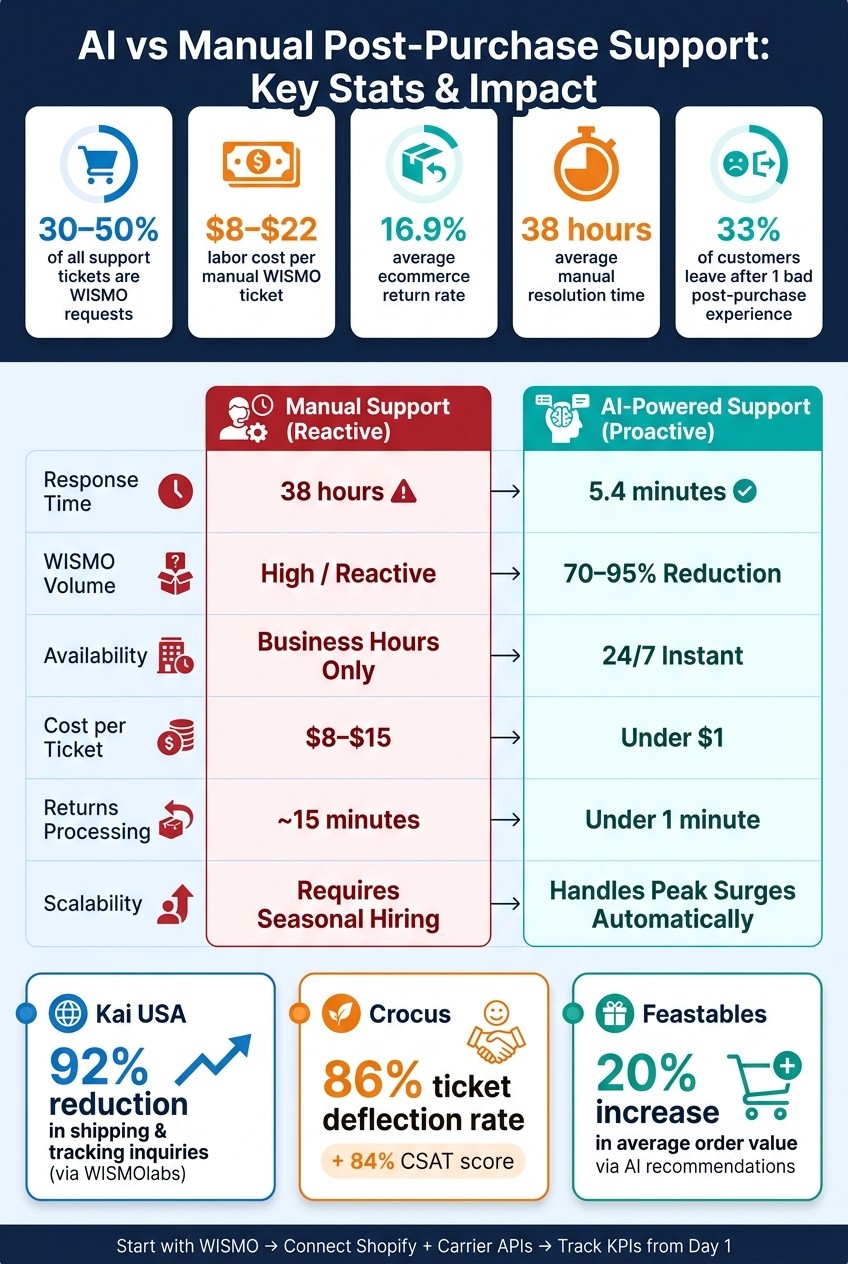
AI vs Manual Post-Purchase Support: Key Stats & Impact
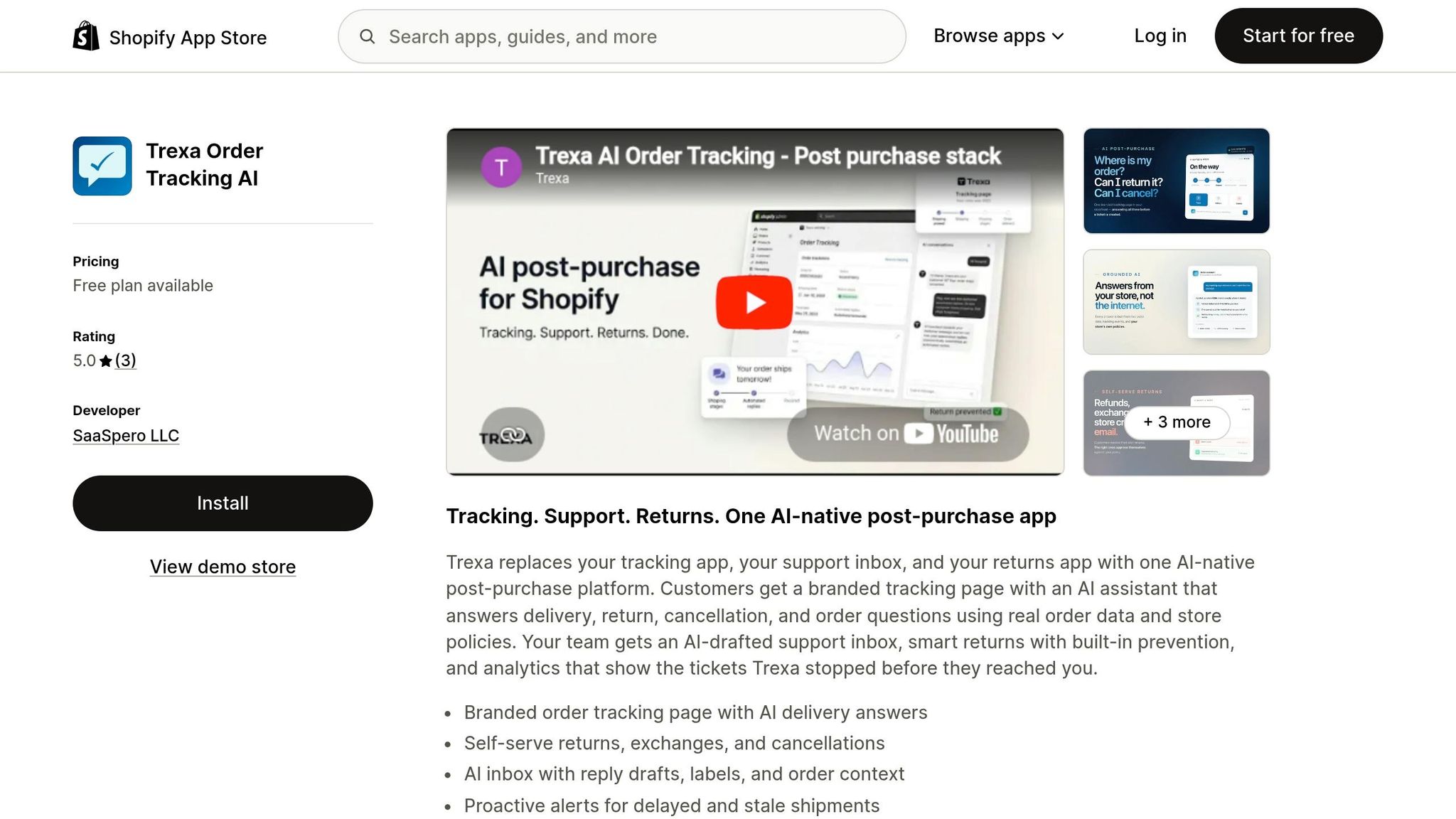
Trexa - AI Powered Shopify Post Purchase Support
Common Post-Purchase Issues in Shopify Dropshipping Store
Post-purchase problems hit harder in dropshipping because fulfillment is split between suppliers and carriers. In a Shopify dropshipping store, a single order can depend on several suppliers at once. That means more handoffs, more chances for delays, and more places where tracking can break down fast.
Delivery Delays, Missing Tracking, and WISMO Requests
Most customers ask "Where is my order?" during one of three moments: the processing gap, when 12 to 48 hours pass after checkout and nothing seems to happen; when a label is created but the carrier still hasn’t scanned the package; or when the shipment gets stuck at a carrier hub.
Once tracking stalls, people usually don’t sit back and wait. They contact support. And in the U.S., shoppers expect live tracking updates, so missing scans often turn into tickets almost right away.
Dropshipping adds even more friction here. It’s not just normal carrier slowdowns. When several suppliers are involved, those gaps stack up. Manual WISMO handling also costs more than most store owners think, with labor costs estimated at $8 to $15 per ticket, and some estimates going as high as $22 once overhead is added in. During peak shopping periods like Black Friday and Cyber Monday, WISMO can account for 50% or more of inbound support volume.
Returns, Refunds, and Support Bottlenecks
Returns and refunds are another common choke point. The average ecommerce return rate is about 16.9%, and in dropshipping, the process often takes longer because merchants may need supplier approval before they can issue a return label or approve the refund.
Then there are the time-sensitive requests: cancellations, address changes, and order edits. These look small on the surface, but they can become messy fast. If the supplier fulfills the order before the request is handled, reversing it may be hard or not possible at all. That can lead to chargebacks. On top of that, these repeat requests eat up a big share of support team time.
A small group of ticket types tends to drive most support spikes:
Ticket Category | % of Total Support Volume | Primary Cause |
|---|---|---|
WISMO (Where Is My Order?) | 30–50% | Communication gaps, carrier delays |
Return Requests | 15–25% | Unclear policies, manual label generation |
Shipping Time Concerns | 10–15% | Vague delivery windows |
Cancellations | 10% | Short window before fulfillment |
Order Modifications | 5% | Address or item changes post-checkout |
Disconnected Communication and Untracked Return Reasons and Negative Review Patterns
A lot of Shopify dropshipping stores run tracking, returns, and support through separate tools. The problem is simple: those tools often don’t share data well. So customers get mixed messages, and support teams end up reacting to problems instead of getting ahead of them.
There’s another issue hiding underneath that. If one supplier keeps sending damaged products or shipping late, that pattern can slip by when return reasons and review sentiment aren’t tracked in one place. By the time the pattern is obvious, the damage may already be done. 33% of customers switch after one negative post-purchase interaction.
That’s where AI starts to matter most: cutting ticket volume, speeding up replies, and spotting repeat issues before they spread.
AI Solutions for the Biggest Post-Purchase Problems
AI can cut WISMO volume, speed up returns, and spot customer pain points before they turn into bigger messes. At a basic level, that comes down to three things: proactive tracking, automated support, and feedback analysis.
AI Tracking, Delay Prediction, and Order Updates
AI can watch live tracking data, spot likely delays, and send updates before a customer has to ask. That matters because most WISMO tickets aren’t hard. They’re just repetitive, and they pile up fast.
Proactive AI-driven delivery notifications can reduce WISMO inquiries by 70% to 95%, and resolution times can drop from an average of 38 hours to just 5.4 minutes. If tracking goes quiet for 5 to 7 days, AI can flag the order and trigger a replacement or refund under a preset dollar threshold.
Dimension | Manual Tracking Emails | AI-Driven Order Updates |
|---|---|---|
Delivery Transparency | Static events, vague ETAs | Predictive ETAs with proactive delay alerts |
WISMO Rate | High volume, reactive handling | 70% to 95% reduction via proactive updates |
Response Time | Minutes to hours | Under 30 seconds |
Cost per Resolution | $8–$15 per ticket | 80% to 90% lower than manual handling |
AI Chatbots, Support Triage, and Automated Returns
Once those proactive updates are live, the tickets that remain need fast triage. AI chatbots can pull live order data from Shopify and carrier systems to answer status questions 24/7. They handle simple tracking requests on their own and pass tougher disputes to human agents.
Returns are another pain point. A manual return takes about 15 minutes. An AI-assisted return portal can handle the same task in under a minute, and it can steer shoppers toward exchanges or store credit. That kind of speed changes the tone of the whole post-purchase experience.
Crocus saw an 86% ticket deflection rate and an 84% CSAT score by using AI for post-purchase questions.
Feature | Human-Only Support | Hybrid AI + Human Support |
|---|---|---|
Response Time | Average 38 hours | Average 5.4 minutes |
Availability | Business hours only | 24/7 instant response |
Scalability | Requires seasonal hiring | Handles peak surges without extra staff |
Returns Process Time | ~15 minutes per request | Under 1 minute |
AI Recommendations, Surveys, and Sentiment Analysis
Once support is stable, AI can do more than put out fires. It can turn delivery moments into feedback loops and extra revenue.
For example, AI can trigger product recommendations or replenishment reminders based on the delivery scan itself, instead of using a fixed send date. It can also send a short survey right after a package is marked "Delivered", which helps brands collect feedback before frustration builds.
Feastables deployed a Certainly AI agent on their Shopify dropshipping store in February 2026 and saw a 20% increase in average order value by turning support conversations into recommendation moments.
AI can also scan incoming messages with NLP for terms like "damaged" and send negative cases to senior agents right away. Kai USA, which runs brands like Kershaw Knives and Shun Cutlery, used proactive AI notifications through WISMOlabs and saw a 92% reduction in weekly customer inquiries tied to shipping and tracking.
Feature | Generic Follow-up Emails | AI-Personalized Recommendations |
|---|---|---|
Content | Static "Thank You" or generic discount | Dynamic upsells based on specific items bought |
Timing | Fixed interval (e.g., 7 days post-purchase) | Event-based, triggered by delivery scan |
Feedback Handling | Manual review of survey results | Real-time sentiment analysis and auto-escalation |
Revenue Impact | Low engagement | Reported 20% increase in AOV (Feastables) |
How to Add AI Post-Purchase Tools to a Shopify Store
Start with Clean Order Data and One High-Impact Use Case
If you want to fix WISMO and support slowdowns, start with the data. AI falls apart when SKUs, product names, carrier details, and customer records don’t line up across systems.
WISMO is the smartest place to begin. It’s repetitive, low-risk, rule-based, high-volume, and simple to measure. That makes it a solid first test instead of trying to automate everything at once.
A simple way to lower risk before launch is to run the AI in "shadow mode" for 5–7 days. Let it process WISMO tickets without sending replies, then compare its answers with what your human agents would send. If the accuracy is there, switch it on.
Once the data is in good shape, connect the tools that make real-time replies possible.
Connect Shopify, Carriers, and Customer Communication Tools
Connect Shopify order data, carrier APIs, and your customer message tools. You need live carrier data for real-time order status. The aim is simple: put order data, shipping updates, and customer messaging into one flow.
Before AI alerts go live, turn off carrier notifications so customers don’t get duplicate messages. Then build the workflow around five states:
Pre-shipment
In Transit
Delayed
Delivered
Exception
Test the setup with 5–10 real orders before launch.
After the integrations are done, run the workflow on a small batch of real orders before rolling it out across the store.
Track Results with Clear Post-Purchase KPIs
You need to know if the system is cutting tickets, speeding up replies, and lowering service cost. Track performance before and after launch.
KPI | Before AI (Baseline) | After AI Implementation |
|---|---|---|
WISMO Ticket Rate | 30%–50% of total tickets | 10%–15% (60%+ reduction) |
Avg. Resolution Time | ~38 hours | ~5.4 minutes |
Support Cost per Ticket | $5.00 average | Under $1 |
At scale, cutting WISMO volume can save hundreds of thousands of dollars per year. That’s why it helps to measure from day one and set a clean baseline.
Risks, Best Practices, and Key Takeaways
Privacy, Accuracy, and Human Review Safeguards
Once AI is live, risk control matters more than rollout speed.
Bad data leads to bad answers. In ecommerce, 62% of AI failures come from poor data preparation, not the tool itself.
Audit policies every six months, and ground AI in live Shopify Admin data instead of static FAQs. Put human approval in place for refunds, order changes, and orders above $500.
Escalate right away when a message shows anger or urgency, or when the issue involves stolen packages, wrong items, or billing disputes. Pass the full thread to the agent so they have the full picture. Sending someone through a bot-only loop when they're already upset is a fast way to lose trust: 53% of customers say they would switch to a competitor if stuck in a bot-only loop.
Risk | Mitigation Strategy |
|---|---|
Inaccurate delivery predictions | Connect AI straight to carrier APIs and Shopify Admin data for real-time tracking |
Over-automation | Set human approval rules for negative sentiment and high-value orders |
Outdated policy responses | Audit help content every 6 months and ground AI in live store data |
With these guardrails in place, the same system can smooth out the customer experience instead of adding more friction.
Key Takeaways for a Better Post-Purchase Experience
Post-purchase is where trust is won or lost. WISMO, returns, and shipping exceptions tend to be the biggest friction points. Start with order status, then expand into returns and delay alerts.
Use clean data, live integrations, and clear escalation rules.
FAQs
Which post-purchase issue should I automate first?
Automate order tracking first. People often call this WISMO ("Where Is My Order?"), and for good reason: it’s the most common post-purchase request, making up about 33% of support tickets.
This is usually the low-hanging fruit. These questions tend to be repetitive, and the answer often comes from a simple data lookup. That makes them a strong fit for automation.
With an automated tracking system, customers can get instant, real-time status updates without needing help from a support agent.
How do I know if AI gives customers accurate updates?
AI works best when it connects straight to live data sources. Instead of leaning on static FAQ pages, it can make real-time API calls to your order management system and carrier networks to pull the latest fulfillment and shipping status.
That matters for a simple reason: customers want the current answer, not yesterday’s answer.
It can also pull data from more than one system at the same time. That helps cut down on conflicting updates and turns complex carrier codes into clear, plain-English messages people can understand fast.
When should a human step in instead of AI?
A human should step in when an issue is complex, sensitive, or calls for judgment that goes beyond standard policy rules.
AI can take care of routine questions, order tracking, and basic returns. But it should pass the conversation to a person when a case involves negative sentiment, damaged goods, lost packages, or unusual edge cases where full context and empathy matter.
Related Blog Posts
Post-purchase problems cost stores money and trust fast. If tracking goes quiet, a refund takes too long, or support replies late, shoppers often open tickets, file disputes, or leave bad reviews.
Here’s the short version: the biggest post-purchase issues are WISMO requests, delivery delays, missing tracking scans, slow returns, refund hold-ups, and disconnected support tools. In many stores, WISMO alone makes up 30% to 50% of support volume, and each manual ticket can cost $3 to $7, or more once labor is added.
The fix is simple in theory: use AI to handle the repeat work and flag the risky cases for people. That usually means:
Order updates sent before customers ask
Chat support tied to Shopify and carrier data
Return flows that cut wait time
Message analysis that spots damage, anger, and repeat supplier issues
Clear rules for when a human steps in
A few numbers show why this matters:
93% of U.S. shoppers say delivery performance shapes how they see a brand
16.9% is the average ecommerce return rate
AI-based order updates can cut WISMO by 70% to 95%
Average resolution time can drop from 38 hours to 5.4 minutes
33% of customers may leave after one bad post-purchase interaction
If I were setting this up on a Shopify dropshipping store, I’d start with WISMO first, connect Shopify with carrier and message tools, test on a small batch of orders, and track ticket rate, reply time, and cost per ticket from day one.
This article breaks down the main problems, the AI tools that help, and the guardrails needed so bad data or bot-only loops don’t make things worse.
AI vs Manual Post-Purchase Support: Key Stats & Impact
Trexa - AI Powered Shopify Post Purchase Support
Common Post-Purchase Issues in Shopify Dropshipping Store
Post-purchase problems hit harder in dropshipping because fulfillment is split between suppliers and carriers. In a Shopify dropshipping store, a single order can depend on several suppliers at once. That means more handoffs, more chances for delays, and more places where tracking can break down fast.
Delivery Delays, Missing Tracking, and WISMO Requests
Most customers ask "Where is my order?" during one of three moments: the processing gap, when 12 to 48 hours pass after checkout and nothing seems to happen; when a label is created but the carrier still hasn’t scanned the package; or when the shipment gets stuck at a carrier hub.
Once tracking stalls, people usually don’t sit back and wait. They contact support. And in the U.S., shoppers expect live tracking updates, so missing scans often turn into tickets almost right away.
Dropshipping adds even more friction here. It’s not just normal carrier slowdowns. When several suppliers are involved, those gaps stack up. Manual WISMO handling also costs more than most store owners think, with labor costs estimated at $8 to $15 per ticket, and some estimates going as high as $22 once overhead is added in. During peak shopping periods like Black Friday and Cyber Monday, WISMO can account for 50% or more of inbound support volume.
Returns, Refunds, and Support Bottlenecks
Returns and refunds are another common choke point. The average ecommerce return rate is about 16.9%, and in dropshipping, the process often takes longer because merchants may need supplier approval before they can issue a return label or approve the refund.
Then there are the time-sensitive requests: cancellations, address changes, and order edits. These look small on the surface, but they can become messy fast. If the supplier fulfills the order before the request is handled, reversing it may be hard or not possible at all. That can lead to chargebacks. On top of that, these repeat requests eat up a big share of support team time.
A small group of ticket types tends to drive most support spikes:
Ticket Category | % of Total Support Volume | Primary Cause |
|---|---|---|
WISMO (Where Is My Order?) | 30–50% | Communication gaps, carrier delays |
Return Requests | 15–25% | Unclear policies, manual label generation |
Shipping Time Concerns | 10–15% | Vague delivery windows |
Cancellations | 10% | Short window before fulfillment |
Order Modifications | 5% | Address or item changes post-checkout |
Disconnected Communication and Untracked Return Reasons and Negative Review Patterns
A lot of Shopify dropshipping stores run tracking, returns, and support through separate tools. The problem is simple: those tools often don’t share data well. So customers get mixed messages, and support teams end up reacting to problems instead of getting ahead of them.
There’s another issue hiding underneath that. If one supplier keeps sending damaged products or shipping late, that pattern can slip by when return reasons and review sentiment aren’t tracked in one place. By the time the pattern is obvious, the damage may already be done. 33% of customers switch after one negative post-purchase interaction.
That’s where AI starts to matter most: cutting ticket volume, speeding up replies, and spotting repeat issues before they spread.
AI Solutions for the Biggest Post-Purchase Problems
AI can cut WISMO volume, speed up returns, and spot customer pain points before they turn into bigger messes. At a basic level, that comes down to three things: proactive tracking, automated support, and feedback analysis.
AI Tracking, Delay Prediction, and Order Updates
AI can watch live tracking data, spot likely delays, and send updates before a customer has to ask. That matters because most WISMO tickets aren’t hard. They’re just repetitive, and they pile up fast.
Proactive AI-driven delivery notifications can reduce WISMO inquiries by 70% to 95%, and resolution times can drop from an average of 38 hours to just 5.4 minutes. If tracking goes quiet for 5 to 7 days, AI can flag the order and trigger a replacement or refund under a preset dollar threshold.
Dimension | Manual Tracking Emails | AI-Driven Order Updates |
|---|---|---|
Delivery Transparency | Static events, vague ETAs | Predictive ETAs with proactive delay alerts |
WISMO Rate | High volume, reactive handling | 70% to 95% reduction via proactive updates |
Response Time | Minutes to hours | Under 30 seconds |
Cost per Resolution | $8–$15 per ticket | 80% to 90% lower than manual handling |
AI Chatbots, Support Triage, and Automated Returns
Once those proactive updates are live, the tickets that remain need fast triage. AI chatbots can pull live order data from Shopify and carrier systems to answer status questions 24/7. They handle simple tracking requests on their own and pass tougher disputes to human agents.
Returns are another pain point. A manual return takes about 15 minutes. An AI-assisted return portal can handle the same task in under a minute, and it can steer shoppers toward exchanges or store credit. That kind of speed changes the tone of the whole post-purchase experience.
Crocus saw an 86% ticket deflection rate and an 84% CSAT score by using AI for post-purchase questions.
Feature | Human-Only Support | Hybrid AI + Human Support |
|---|---|---|
Response Time | Average 38 hours | Average 5.4 minutes |
Availability | Business hours only | 24/7 instant response |
Scalability | Requires seasonal hiring | Handles peak surges without extra staff |
Returns Process Time | ~15 minutes per request | Under 1 minute |
AI Recommendations, Surveys, and Sentiment Analysis
Once support is stable, AI can do more than put out fires. It can turn delivery moments into feedback loops and extra revenue.
For example, AI can trigger product recommendations or replenishment reminders based on the delivery scan itself, instead of using a fixed send date. It can also send a short survey right after a package is marked "Delivered", which helps brands collect feedback before frustration builds.
Feastables deployed a Certainly AI agent on their Shopify dropshipping store in February 2026 and saw a 20% increase in average order value by turning support conversations into recommendation moments.
AI can also scan incoming messages with NLP for terms like "damaged" and send negative cases to senior agents right away. Kai USA, which runs brands like Kershaw Knives and Shun Cutlery, used proactive AI notifications through WISMOlabs and saw a 92% reduction in weekly customer inquiries tied to shipping and tracking.
Feature | Generic Follow-up Emails | AI-Personalized Recommendations |
|---|---|---|
Content | Static "Thank You" or generic discount | Dynamic upsells based on specific items bought |
Timing | Fixed interval (e.g., 7 days post-purchase) | Event-based, triggered by delivery scan |
Feedback Handling | Manual review of survey results | Real-time sentiment analysis and auto-escalation |
Revenue Impact | Low engagement | Reported 20% increase in AOV (Feastables) |
How to Add AI Post-Purchase Tools to a Shopify Store
Start with Clean Order Data and One High-Impact Use Case
If you want to fix WISMO and support slowdowns, start with the data. AI falls apart when SKUs, product names, carrier details, and customer records don’t line up across systems.
WISMO is the smartest place to begin. It’s repetitive, low-risk, rule-based, high-volume, and simple to measure. That makes it a solid first test instead of trying to automate everything at once.
A simple way to lower risk before launch is to run the AI in "shadow mode" for 5–7 days. Let it process WISMO tickets without sending replies, then compare its answers with what your human agents would send. If the accuracy is there, switch it on.
Once the data is in good shape, connect the tools that make real-time replies possible.
Connect Shopify, Carriers, and Customer Communication Tools
Connect Shopify order data, carrier APIs, and your customer message tools. You need live carrier data for real-time order status. The aim is simple: put order data, shipping updates, and customer messaging into one flow.
Before AI alerts go live, turn off carrier notifications so customers don’t get duplicate messages. Then build the workflow around five states:
Pre-shipment
In Transit
Delayed
Delivered
Exception
Test the setup with 5–10 real orders before launch.
After the integrations are done, run the workflow on a small batch of real orders before rolling it out across the store.
Track Results with Clear Post-Purchase KPIs
You need to know if the system is cutting tickets, speeding up replies, and lowering service cost. Track performance before and after launch.
KPI | Before AI (Baseline) | After AI Implementation |
|---|---|---|
WISMO Ticket Rate | 30%–50% of total tickets | 10%–15% (60%+ reduction) |
Avg. Resolution Time | ~38 hours | ~5.4 minutes |
Support Cost per Ticket | $5.00 average | Under $1 |
At scale, cutting WISMO volume can save hundreds of thousands of dollars per year. That’s why it helps to measure from day one and set a clean baseline.
Risks, Best Practices, and Key Takeaways
Privacy, Accuracy, and Human Review Safeguards
Once AI is live, risk control matters more than rollout speed.
Bad data leads to bad answers. In ecommerce, 62% of AI failures come from poor data preparation, not the tool itself.
Audit policies every six months, and ground AI in live Shopify Admin data instead of static FAQs. Put human approval in place for refunds, order changes, and orders above $500.
Escalate right away when a message shows anger or urgency, or when the issue involves stolen packages, wrong items, or billing disputes. Pass the full thread to the agent so they have the full picture. Sending someone through a bot-only loop when they're already upset is a fast way to lose trust: 53% of customers say they would switch to a competitor if stuck in a bot-only loop.
Risk | Mitigation Strategy |
|---|---|
Inaccurate delivery predictions | Connect AI straight to carrier APIs and Shopify Admin data for real-time tracking |
Over-automation | Set human approval rules for negative sentiment and high-value orders |
Outdated policy responses | Audit help content every 6 months and ground AI in live store data |
With these guardrails in place, the same system can smooth out the customer experience instead of adding more friction.
Key Takeaways for a Better Post-Purchase Experience
Post-purchase is where trust is won or lost. WISMO, returns, and shipping exceptions tend to be the biggest friction points. Start with order status, then expand into returns and delay alerts.
Use clean data, live integrations, and clear escalation rules.
FAQs
Which post-purchase issue should I automate first?
Automate order tracking first. People often call this WISMO ("Where Is My Order?"), and for good reason: it’s the most common post-purchase request, making up about 33% of support tickets.
This is usually the low-hanging fruit. These questions tend to be repetitive, and the answer often comes from a simple data lookup. That makes them a strong fit for automation.
With an automated tracking system, customers can get instant, real-time status updates without needing help from a support agent.
How do I know if AI gives customers accurate updates?
AI works best when it connects straight to live data sources. Instead of leaning on static FAQ pages, it can make real-time API calls to your order management system and carrier networks to pull the latest fulfillment and shipping status.
That matters for a simple reason: customers want the current answer, not yesterday’s answer.
It can also pull data from more than one system at the same time. That helps cut down on conflicting updates and turns complex carrier codes into clear, plain-English messages people can understand fast.
When should a human step in instead of AI?
A human should step in when an issue is complex, sensitive, or calls for judgment that goes beyond standard policy rules.
AI can take care of routine questions, order tracking, and basic returns. But it should pass the conversation to a person when a case involves negative sentiment, damaged goods, lost packages, or unusual edge cases where full context and empathy matter.
Related Blog Posts
Get your store!
© 2025 BuildMyStores
© 2025 BuildMyStores