🎉 Start Shopify’s $1 Plan and We’ll pay you up to $3,600 just for starting! 💸 — Limited Time
Get Limited Time Offer 💰
Offer Details — Rewards require completing eligible third-party offers. Reward amounts vary from $30 to $3,600. Terms and eligibility restrictions apply.
🎉 Start Shopify’s $1 Plan and We’ll pay you up to $3,600 just for starting! 💸 — Limited Time
Get Limited Time Offer 💰
Offer Details — Rewards require completing eligible third-party offers. Reward amounts vary from $30 to $3,600. Terms and eligibility restrictions apply.
🎉 Start Shopify’s $1 Plan and We’ll pay you up to $3,600 just for starting! 💸 — Limited Time
Get Limited Time Offer 💰
Offer Details — Rewards require completing eligible third-party offers. Reward amounts vary from $30 to $3,600. Terms and eligibility restrictions apply.
Ecommerce Strategies
Brand Consistency vs. Market Adaptation
Brand Consistency vs. Market Adaptation

If you're selling online to a global audience, you face a tough question: Should your brand look the same everywhere, or should it change to fit local markets? Staying consistent builds trust and saves costs, but tailoring to local preferences can win over more customers.
Here's the challenge: 33% more revenue comes from consistent branding, but 76% of consumers prefer products in their native language. The best brands find a balance - keeping their core identity intact while adjusting to local needs.
Key points:
Brand Consistency: Builds trust, recognition, and loyalty. Examples include Apple and Coca-Cola maintaining global themes.
Market Adaptation: Tailors products and messaging to local preferences. Think McDonald’s vegetarian menu in India or IKEA's smaller furniture for Japan.
The goal is to blend both approaches, ensuring your brand feels global yet relevant locally. Whether you’re a Shopify business or a global giant, this balance can drive growth and customer satisfaction.
Balancing Brand Consistency and Localization | Alconost
What Brand Consistency Means in Global eCommerce
Brand consistency is all about ensuring that your brand’s key elements - like your logo, colors, typography, tone, and messaging - stay the same no matter where in the world your customers encounter them. Whether someone in Tokyo or New York interacts with your brand, it should deliver the same look, feel, and experience. This uniformity isn’t just about aesthetics; it’s about building trust and creating seamless customer experiences.
In the world of global eCommerce, where most interactions happen digitally, consistency becomes your virtual handshake. A cohesive brand presence eliminates confusion and reassures customers, making them more likely to hit "buy". Research backs this up: 92% of global consumers value consistent messaging across all touchpoints, and 90% expect a unified experience across websites, social media, and other platforms.
The financial upside is hard to ignore. Companies with consistent branding are valued up to 20% higher than competitors who fail to align their messaging across markets. Consistency fuels recognition, which in turn drives revenue and fosters the kind of loyalty that strengthens brand equity over time.
However, achieving this level of consistency requires internal alignment. Every department must reflect the same core values. When there’s a disconnect between how a brand operates internally and how it presents externally, customer trust can take a hit.
That said, consistency doesn’t mean rigidity. It’s about identifying the non-negotiable elements - your brand’s core identity - and knowing what can be adjusted to suit local markets. This "glocal" approach balances global standards with local relevance, ensuring that your brand resonates with diverse audiences while staying true to its essence.
Why Brand Consistency Works
Consistency builds recognition on a global scale. When customers see the same logo, colors, and messaging across different countries and platforms, it creates familiarity, which leads to trust. And trust? That’s what drives purchases and loyalty.
Take Apple, for instance. Its sleek, standardized product design is instantly recognizable worldwide and reinforces its premium image. Coca-Cola offers another great example. Its iconic red-and-white logo and "happiness" messaging are consistent across markets, from Brazil to South Africa to Canada. Yet, Coca-Cola also adapts where needed - like tweaking flavors for local tastes - without losing its global identity. This balance between consistency and adaptation has helped it become one of the world’s most valuable brands.
By maintaining a consistent presence, brands reduce the need to reintroduce themselves in every new market. This lowers the barrier to entry for customers, encouraging repeat purchases and long-term loyalty.
Difficulties of Keeping Brands Consistent
While a consistent brand presence is powerful, maintaining it globally is no small task. The biggest challenge is finding the right balance between standardization and adaptation. Over-standardizing can make your brand seem tone-deaf to local cultures, while too much adaptation risks diluting your identity.
Cultural and linguistic differences add another layer of complexity. Colors, symbols, and even numbers can carry vastly different meanings across regions. And then there’s the "Translation Trap", where literal translations can strip away the essence of your brand. Yet, with 76% of consumers more likely to consider a product when information is in their native language, localization can’t be ignored.
Legal and regulatory differences also come into play. Advertising claims, product safety standards, and labeling laws vary from country to country. What works in the U.S. might need significant tweaks elsewhere, requiring brands to juggle multiple versions of packaging and marketing materials - all while trying to maintain a consistent look and feel.
Internal challenges can be just as daunting. Brand guidelines, sometimes hundreds of pages long, are often ignored by local teams who need flexibility to meet regional demands. This can lead to "brand drift", where the global identity fractures as regional offices take creative liberties.
"A brand that can't adapt to local markets risks becoming globally irrelevant, but one that adapts too much ceases to be a brand at all." - Sophie Kim, Branding Weekly
Tesco PLC’s failed U.S. venture, "Fresh & Easy", is a cautionary tale. In 2013, the company pulled out of the market after losing over $1 billion. Why? Its reluctance to adapt to American shopping preferences. Even strong brands need to know when to hold the line on consistency and when to bend to local needs.
Market Adaptation: Why Localization Matters
Market adaptation involves tailoring products, marketing strategies, and operations to align with local preferences, laws, and economic conditions. It’s the opposite of a one-size-fits-all approach. Instead of offering the same product and message everywhere, businesses adjust based on where their customers live.
Localization is essential. Legal standards differ across countries. For instance, the European Union enforces strict rules on food additives. Similarly, cultural norms - like whether a society leans toward individualism or collectivism - shape consumer behavior and risk tolerance. By adapting to these norms, brands can appear relatable rather than out of touch.
Economic conditions also play a role. Pricing strategies that work in the U.S. might alienate buyers in developing markets. Companies like Nestlé address this by offering smaller, more affordable packaging in regions with lower purchasing power. Adapting also allows businesses to compete with local brands that already have deep market insights and loyal customer bases.
The numbers back this up. Global business partnerships rose 44% between 2023 and 2024 compared to a decade earlier, while collaborations between multinational companies and local partners surged 230% from 2014 to 2024. This shift shows that succeeding in global eCommerce isn’t just about shipping products worldwide - it’s about understanding and meeting the unique needs of each market.
"The world's shift to multipolarity is rewriting the rules of global business operations. Companies that succeed in this unfamiliar environment will root themselves deeply in every region they serve." - Muqsit Ashraf, Tomas Castagnino, and Giju Mathew
Benefits of Adapting to Local Markets
Effective localization can boost customer engagement and loyalty by showing that you understand their needs. Tailoring messaging, products, and even payment options makes customers feel valued and builds trust.
Take McDonald’s, for example. In India, where many people avoid beef for cultural and religious reasons, the company introduced the McAloo Tikki, a vegetarian burger with a spiced potato patty. This move respected local traditions while staying true to the McDonald’s brand, helping the company thrive in the market.
Localization also helps navigate regulatory challenges. For instance, Microsoft addressed European sovereignty laws by committing to store European data locally.
Another advantage is pricing flexibility. By adjusting prices to reflect local purchasing power, companies can unlock markets that might otherwise be out of reach. Xiaomi, for example, designed phones with extended battery life for India, where power outages are more frequent. This kind of adaptation shows customers that you’re paying attention to their specific needs.
The financial benefits are clear. Businesses that localize strategically often see higher conversion rates and better customer retention. Plus, by diversifying across multiple markets, they reduce their exposure to economic downturns in any single region. However, while the rewards are substantial, localization comes with its own set of challenges.
Downsides of Market Adaptation
Localization isn’t always smooth sailing. One major risk is brand dilution. Over-adapting can strip away the core identity that made your brand successful in the first place. If your products, messaging, and visuals vary too much across markets, customers might not recognize your brand, weakening its value.
Then there’s the cost. Developing market-specific campaigns, packaging, and product variations can be expensive. Managing multiple localized efforts instead of a single global campaign can quickly eat into profits.
Operational challenges add to the complexity. Coordinating between global headquarters and local teams, managing region-specific content, and staying compliant with local regulations require significant resources. In fact, 81% of companies report issues with off-brand content being published, often because local teams take too much creative freedom. This inconsistency can hurt your brand’s image.
Over-localization can also slow down product launches and waste resources. Research shows that many consumer needs - like quality, security, and belonging - are universal and don’t require as much localization as some local managers claim.
The real challenge lies in finding the right balance. As one expert put it, too much localization risks fragmenting your brand identity, confusing customers, and diluting its value. Striking that balance is key to maintaining a strong global presence while staying relevant locally.
Brand Consistency vs. Market Adaptation: Side-by-Side Comparison
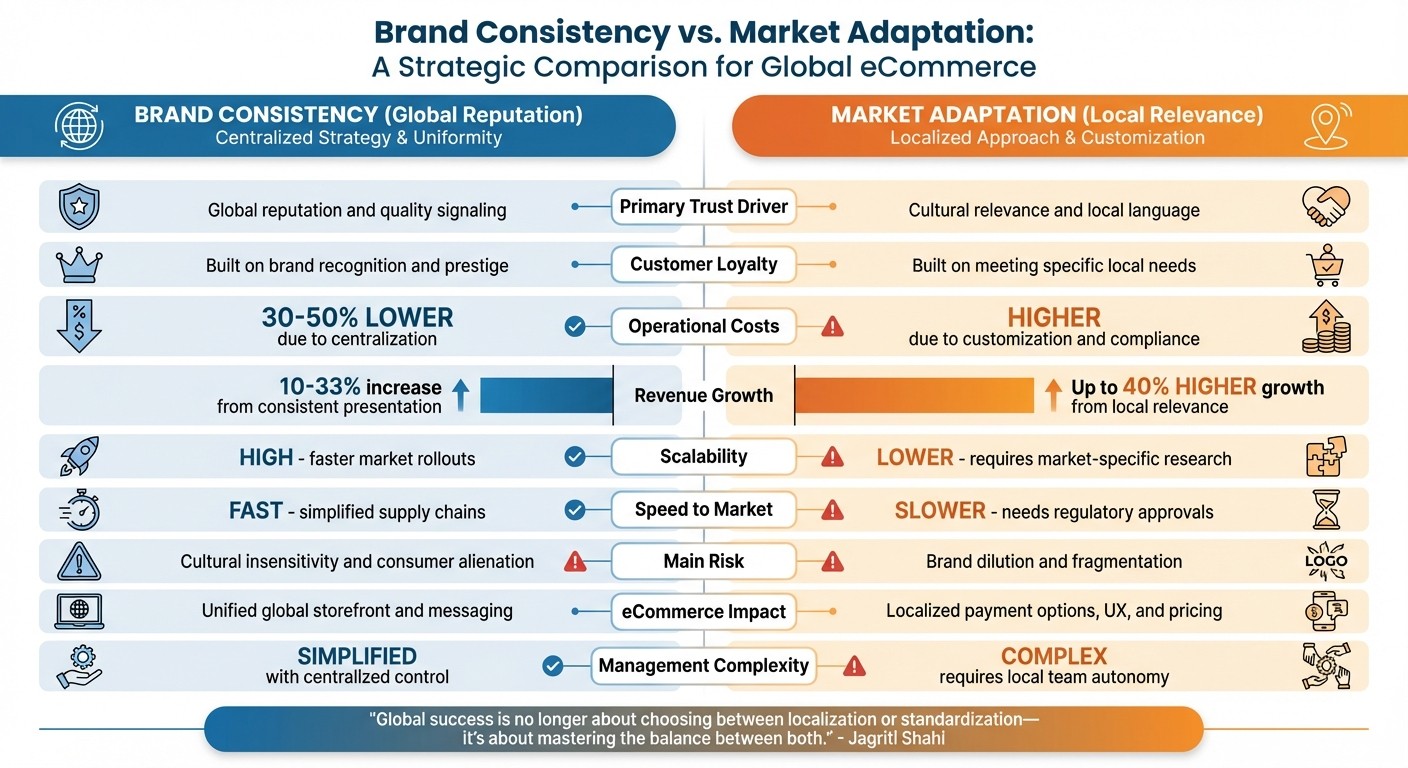
Brand Consistency vs Market Adaptation: Key Differences for Global eCommerce
When comparing brand consistency and market adaptation, the differences come down to how each approach builds trust and drives results. Brand consistency establishes trust through global recognition. A consistent presence across markets signals quality and reliability - when customers see your brand everywhere, they’re likely to associate it with dependability and innovation. On the other hand, market adaptation builds trust by aligning with local preferences and cultural nuances. Rather than relying on broad statistics, the results speak for themselves: localized strategies often lead to higher conversion rates and improved customer lifetime value.
From a cost perspective, standardized branding can reduce operational expenses by 30–50% due to centralized processes. However, localized approaches can boost revenue by as much as 40%, creating a clear trade-off: brand consistency saves money, while market adaptation drives sales. Striking a balance between the two is essential for achieving global eCommerce success.
Consistency also allows for quicker market rollouts, thanks to unified supply chains and streamlined operations. Meanwhile, localization requires more time for in-depth market research and navigating regulatory approvals, slowing expansion. Yet, the slower approach often proves worthwhile - 44% of global product launches fail due to poor localization, pricing issues, or cultural mismatches.
"Global success is no longer about choosing between localization or standardization - it's about mastering the balance between both." - Jagriti Shahi
The decision isn’t about choosing one approach over the other. Instead, it’s about finding the right combination for your market and product. For instance, tech products often lean toward standardization because their functionality is universally understood. In contrast, industries like food and fashion, which are deeply tied to cultural preferences, require more localized strategies.
Comparison Table: Strengths and Weaknesses
Factor | Brand Consistency | Market Adaptation |
|---|---|---|
Primary Trust Driver | Global reputation and quality signaling | Cultural relevance and local language |
Customer Loyalty | Built on brand recognition and prestige | Built on meeting specific local needs |
Operational Costs | 30–50% lower due to centralization | Higher due to customization and compliance |
Revenue Growth | 10–33% increase from consistent presentation | Up to 40% higher growth from local relevance |
Scalability | High; faster market rollouts | Lower; requires market-specific research |
Speed to Market | Fast; simplified supply chains | Slower; needs regulatory approvals |
Main Risk | Cultural insensitivity and consumer alienation | Brand dilution and fragmentation |
eCommerce Impact | Unified global storefront and messaging | Localized payment options, UX, and pricing |
Management Complexity | Simplified with centralized control | Complex; requires local team autonomy |
Next, we’ll dive into case studies that highlight how these strategies play out in real-world scenarios.
Case Studies: How Successful Brands Handle This Balance
Let’s dive into how some well-known brands manage to blend consistency with local adaptation.
Coca-Cola's "Share a Coke" Campaign
Coca-Cola’s "Share a Coke" campaign is a masterclass in maintaining a unified identity while embracing local flavors. The brand stuck to its iconic red-and-white design and the globally recognized "Share a Coke with…" tagline, but added a personal twist by incorporating local names and cultural elements.
In Australia, Coca-Cola printed 150 of the most popular local names, like "Sophie" and "Lachlan", alongside colloquial terms like "Mate." This resonated so well with consumers that it led to the sale of 250 million personalized bottles in a country with just 23 million people. The campaign also boosted Coca-Cola’s category share by 4% and increased consumption among young adults by 7%.
In China, where the diversity of characters made printing individual names difficult, Coca-Cola shifted gears. They used relationship-based titles like "Roommate" (室友), "Bro" (老兄), and "Goddess" (女神), reflecting the collectivist culture’s emphasis on group identity.
South Africa took localization even further with the "Phonetic Can" campaign. Names were printed as they’re pronounced, including unique linguistic elements. This approach drove a 158% increase in "brand love", 90% market penetration, and a 5.4% rise in sales volume. In the U.S., the campaign reversed a decade-long sales decline, achieving a 2% increase.
"Coca-Cola turns everyday words into brand assets by using names, messaging and local dialects that reflect how people connect with one another." - Digital Silk
The campaign eventually spanned over 80 countries, proving that personalization works best when it aligns with local sensibilities. Coca-Cola even developed custom typefaces, like a specific Arabic font, to ensure local names fit seamlessly into its branding.
Apple's Global Strategy with Local Adjustments
Apple takes a “standardize the core, customize the periphery” approach. The company stays consistent with its sleek hardware design, minimalist user interface, and innovation-focused marketing themes. This strategy has helped Apple generate over 60% of its revenue from international markets.
Localization is handled strategically. Apple’s websites feature region-specific prompts, local customer service numbers, and live chat in native languages during checkout. While retail stores share a minimalist aesthetic worldwide, Apple tailors each location to feel in harmony with its surroundings.
"Make sure the store has an inviting appeal that matches its surrounding culture and environment. It's about 'getting out into the street' and feeling what the local feels." - Apple VP of retail development
Apple also tweaks its products for regional preferences. For instance, in China, the company offers larger screens and enhanced camera features to cater to local demand. Global campaigns, like the iconic "Think Different", adapt their tone for specific markets. In Japan, for example, the "I'm a Mac, I'm a PC" campaign was softened to position the Mac as a fun, weekend-friendly device.
Apple’s cultural awareness extends to special projects. For the 2025 Lunar New Year, Apple released a short film, Want to Listen to Songs with You, directed by Michael Gracey and shot on the iPhone 16 Pro. The film targeted audiences in China, Hong Kong, Taiwan, and Singapore. Additionally, Apple introduced products like the "Year of the Snake" AirPods 4 with custom engravings for Asian markets.
IKEA's Mix of Standardization and Localization

IKEA sticks to its core principles - like flat-pack furniture and Scandinavian design - while adjusting pricing, marketing, and product offerings for local markets. This approach has helped IKEA open over 450 stores in 52 countries, generating about $42 billion in annual revenue.
China offers a great example of IKEA’s adaptability. Initially, the Western DIY assembly model didn’t resonate with Chinese consumers, who often view self-assembly as inconvenient. IKEA responded by partnering with local assembly services and placing stores near public transit hubs. By 2019, these adjustments helped boost sales in China to $1.6 billion.
"We have taken the concept and planted it in many different countries. Since the concept has been unique and together with the Swedish touch... we have stood for something different from the local, domestic competition." - Anders Dahlvig, Former CEO, IKEA Group
IKEA also tailors its product dimensions to fit local living spaces. After initially failing in Japan in 1974 due to oversized furniture, IKEA returned in 2006 with solutions for small spaces and professional assembly services. In India, where the first store opened in 2018, IKEA included compact furniture and revamped its food menu, replacing beef and pork meatballs with vegetarian options. Even the in-store restaurant concept adapts - offering Matcha Lattes in China and vegetarian dishes in India.
How to Balance Brand Consistency and Market Adaptation in Shopify Dropshipping

When running a Shopify dropshipping business, finding the right balance between maintaining a consistent brand identity and tailoring your approach to different markets is key. The trick lies in knowing which elements of your brand should stay the same and which ones need to adapt based on data and local preferences.
Research Your Target Markets
Start by diving into your analytics. Tools like Google Analytics can help you segment traffic by region. For instance, if you notice high conversion rates but low traffic from a specific country, it’s a clear sign to focus on localization there. The numbers back this up: personalized eCommerce websites often see 10% to 15% higher conversion rates and 20% higher customer satisfaction.
Before entering a new market, research what drives local shoppers. For example:
German customers value detailed technical specs and early delivery updates.
French shoppers respond to curated collections and emotionally driven, lifestyle-oriented content.
U.S. consumers look for prominent reviews and fast, clear call-to-action buttons.
These insights are more than just trivia - they directly influence buying decisions.
"What's the value of doing localization to open up five new markets versus growing three times as much in one market?" - Derek Gleason, Senior Content Lead, Shopify
A smart approach is to test one market before scaling globally. Take Riley, a sustainable period care brand. In 2025, they expanded from Ireland to Germany by tailoring their content to highlight sustainability - an important value for German shoppers. They adjusted their messaging while staying true to their B Corp identity. This allowed them to collect data and refine their strategy before committing larger resources.
Armed with this kind of market knowledge, you can adapt your messaging to better connect with local audiences.
Customize Messaging and Products for Each Market
Once you’ve identified your target markets, focus on adapting how you communicate while keeping the what consistent. Your logo, core colors, and overall brand personality can remain unchanged, but your messaging and product presentation should align with local preferences.
Localization goes beyond simple translation. It involves:
Offering preferred payment methods (e.g., 70% of transactions in the Netherlands use iDEAL).
Displaying prices in local currencies, as over 92% of shoppers prefer this.
Using visuals that resonate with regional audiences.
For example, Australian fashion retailer Petal & Pup localized their eCommerce site for New Zealand, Canada, and the UAE, customizing content and imagery for each region. This strategy helped international sales grow to account for 20% of the brand's total revenue.
Transparency also plays a big role. Nearly 50% of international shoppers abandon their carts when unexpected costs like duties and taxes aren’t disclosed upfront. To build trust, use subfolders for your international URLs (e.g., brand.com/fr-fr) to maintain SEO authority, and implement hreflang tags so search engines show the right language version to users.
"Our biggest learning is that you can't just copy-paste the same message everywhere and expect it to resonate. The key is to really listen and adapt how you communicate, without also losing sight of what makes your brand unique." - Fiona Parfrey, Cofounder, Riley
Once your strategy is in place, automation tools can make execution much easier.
Using BuildMyStores for Global and Local Branding
Platforms like BuildMyStores simplify the process of balancing brand consistency with localized adjustments. Using AI, it generates product pages in multiple languages while ensuring your brand voice remains intact. It also automatically configures settings like local currencies, measurement units, and date formats.
The advantage? Speed. AI-powered tools can cut launch times by up to 90%, enabling you to test multiple markets simultaneously. This is crucial given that 75% of consumers prefer shopping in their native language, and 40% won’t buy from a site that isn’t translated.
The platform also lets you tweak layouts and color schemes to suit regional preferences - minimalist designs for Europe, vibrant ones for Asia - while keeping core branding elements consistent. Plus, since it’s built on Shopify, you can use Shopify Markets to manage multiple countries from a single admin dashboard or create separate stores for regions requiring more autonomy.
Sean Frank, CEO of wallet brand Ridge, shared in October 2025 that Shopify Markets helped his company provide localized inventory and currency options. Without these efforts, they would miss out on 60% of shoppers in key markets like France. BuildMyStores equips businesses to capture these opportunities right from the start, allowing you to focus on refining your message instead of dealing with technical hurdles.
Conclusion: Finding the Right Balance for Global eCommerce
Success in global eCommerce hinges on striking the right balance between maintaining brand consistency and adapting to local markets. Consider this: 72% of global consumers prefer to buy from brands that communicate in their local language. This highlights the importance of blending a unified global identity with localized strategies.
The solution lies in adopting a "Glocal" approach. Keep your core brand elements - such as your mission, logo, and values - consistent across all markets. These are your non-negotiables. Then, tailor other aspects like messaging, product offerings, payment methods, and visuals to align with local preferences. This dual approach ensures your brand remains globally recognizable while resonating with local audiences.
The numbers back this up. Companies that localize their customer experience report up to 40% higher revenue growth compared to those that don’t. On the flip side, 44% of global product launches fail due to poor adaptation or cultural missteps. These figures emphasize the need to test your strategy on a smaller scale, analyze the data, and refine before scaling up. A well-balanced global-local strategy isn’t just smart - it’s essential.
For entrepreneurs, technology can simplify this balancing act. Platforms like BuildMyStores offer tools to maintain your global brand identity while adapting to local market demands. Features like multi-language product pages, local currency support, and regional formatting eliminate technical hurdles, allowing you to focus on growing your business. This makes it easier to explore new markets without draining time or resources.
With the global eCommerce market projected to reach $6.3 trillion by 2025, the opportunities are massive. Those who can master the art of blending consistency with adaptability will be well-positioned to claim a significant share of this growth. Define your core brand principles, research your target markets thoroughly, and refine your strategy to scale. The time to act is now - start optimizing your approach to capture global opportunities.
FAQs
What parts of my brand should never change across countries?
Core elements such as your logo, brand name, and tagline should stay consistent to build recognition and trust. These key components are the face of your brand and ensure a unified identity across the globe. However, elements like imagery, colors, or messaging can be tailored to align with local tastes, as long as they reflect your brand’s core identity. Striking this balance helps maintain your global presence while resonating with local audiences.
How do I know when localization is worth the extra cost?
Localization can be a smart investment when it helps grow your revenue by adapting your store to fit local tastes and preferences. This approach can enhance trust and improve conversion rates. It’s particularly useful when entering new markets, dealing with slow domestic growth, or looking to diversify your income sources. Prioritize localization when the potential to expand your audience and boost customer engagement justifies the expense, especially if it supports your long-term growth strategy.
How can I localize language and checkout without losing my brand voice?
To tailor language and checkout processes while keeping your brand's personality intact, prioritize translations that reflect your tone and messaging accurately. Adjust visuals, user interfaces, and checkout steps to align with local preferences, including popular payment methods and currency formats. Balancing consistent brand identity with local expectations helps create a smooth, trustworthy experience that connects with global customers and encourages them to complete their purchases.
Related Blog Posts
If you're selling online to a global audience, you face a tough question: Should your brand look the same everywhere, or should it change to fit local markets? Staying consistent builds trust and saves costs, but tailoring to local preferences can win over more customers.
Here's the challenge: 33% more revenue comes from consistent branding, but 76% of consumers prefer products in their native language. The best brands find a balance - keeping their core identity intact while adjusting to local needs.
Key points:
Brand Consistency: Builds trust, recognition, and loyalty. Examples include Apple and Coca-Cola maintaining global themes.
Market Adaptation: Tailors products and messaging to local preferences. Think McDonald’s vegetarian menu in India or IKEA's smaller furniture for Japan.
The goal is to blend both approaches, ensuring your brand feels global yet relevant locally. Whether you’re a Shopify business or a global giant, this balance can drive growth and customer satisfaction.
Balancing Brand Consistency and Localization | Alconost
What Brand Consistency Means in Global eCommerce
Brand consistency is all about ensuring that your brand’s key elements - like your logo, colors, typography, tone, and messaging - stay the same no matter where in the world your customers encounter them. Whether someone in Tokyo or New York interacts with your brand, it should deliver the same look, feel, and experience. This uniformity isn’t just about aesthetics; it’s about building trust and creating seamless customer experiences.
In the world of global eCommerce, where most interactions happen digitally, consistency becomes your virtual handshake. A cohesive brand presence eliminates confusion and reassures customers, making them more likely to hit "buy". Research backs this up: 92% of global consumers value consistent messaging across all touchpoints, and 90% expect a unified experience across websites, social media, and other platforms.
The financial upside is hard to ignore. Companies with consistent branding are valued up to 20% higher than competitors who fail to align their messaging across markets. Consistency fuels recognition, which in turn drives revenue and fosters the kind of loyalty that strengthens brand equity over time.
However, achieving this level of consistency requires internal alignment. Every department must reflect the same core values. When there’s a disconnect between how a brand operates internally and how it presents externally, customer trust can take a hit.
That said, consistency doesn’t mean rigidity. It’s about identifying the non-negotiable elements - your brand’s core identity - and knowing what can be adjusted to suit local markets. This "glocal" approach balances global standards with local relevance, ensuring that your brand resonates with diverse audiences while staying true to its essence.
Why Brand Consistency Works
Consistency builds recognition on a global scale. When customers see the same logo, colors, and messaging across different countries and platforms, it creates familiarity, which leads to trust. And trust? That’s what drives purchases and loyalty.
Take Apple, for instance. Its sleek, standardized product design is instantly recognizable worldwide and reinforces its premium image. Coca-Cola offers another great example. Its iconic red-and-white logo and "happiness" messaging are consistent across markets, from Brazil to South Africa to Canada. Yet, Coca-Cola also adapts where needed - like tweaking flavors for local tastes - without losing its global identity. This balance between consistency and adaptation has helped it become one of the world’s most valuable brands.
By maintaining a consistent presence, brands reduce the need to reintroduce themselves in every new market. This lowers the barrier to entry for customers, encouraging repeat purchases and long-term loyalty.
Difficulties of Keeping Brands Consistent
While a consistent brand presence is powerful, maintaining it globally is no small task. The biggest challenge is finding the right balance between standardization and adaptation. Over-standardizing can make your brand seem tone-deaf to local cultures, while too much adaptation risks diluting your identity.
Cultural and linguistic differences add another layer of complexity. Colors, symbols, and even numbers can carry vastly different meanings across regions. And then there’s the "Translation Trap", where literal translations can strip away the essence of your brand. Yet, with 76% of consumers more likely to consider a product when information is in their native language, localization can’t be ignored.
Legal and regulatory differences also come into play. Advertising claims, product safety standards, and labeling laws vary from country to country. What works in the U.S. might need significant tweaks elsewhere, requiring brands to juggle multiple versions of packaging and marketing materials - all while trying to maintain a consistent look and feel.
Internal challenges can be just as daunting. Brand guidelines, sometimes hundreds of pages long, are often ignored by local teams who need flexibility to meet regional demands. This can lead to "brand drift", where the global identity fractures as regional offices take creative liberties.
"A brand that can't adapt to local markets risks becoming globally irrelevant, but one that adapts too much ceases to be a brand at all." - Sophie Kim, Branding Weekly
Tesco PLC’s failed U.S. venture, "Fresh & Easy", is a cautionary tale. In 2013, the company pulled out of the market after losing over $1 billion. Why? Its reluctance to adapt to American shopping preferences. Even strong brands need to know when to hold the line on consistency and when to bend to local needs.
Market Adaptation: Why Localization Matters
Market adaptation involves tailoring products, marketing strategies, and operations to align with local preferences, laws, and economic conditions. It’s the opposite of a one-size-fits-all approach. Instead of offering the same product and message everywhere, businesses adjust based on where their customers live.
Localization is essential. Legal standards differ across countries. For instance, the European Union enforces strict rules on food additives. Similarly, cultural norms - like whether a society leans toward individualism or collectivism - shape consumer behavior and risk tolerance. By adapting to these norms, brands can appear relatable rather than out of touch.
Economic conditions also play a role. Pricing strategies that work in the U.S. might alienate buyers in developing markets. Companies like Nestlé address this by offering smaller, more affordable packaging in regions with lower purchasing power. Adapting also allows businesses to compete with local brands that already have deep market insights and loyal customer bases.
The numbers back this up. Global business partnerships rose 44% between 2023 and 2024 compared to a decade earlier, while collaborations between multinational companies and local partners surged 230% from 2014 to 2024. This shift shows that succeeding in global eCommerce isn’t just about shipping products worldwide - it’s about understanding and meeting the unique needs of each market.
"The world's shift to multipolarity is rewriting the rules of global business operations. Companies that succeed in this unfamiliar environment will root themselves deeply in every region they serve." - Muqsit Ashraf, Tomas Castagnino, and Giju Mathew
Benefits of Adapting to Local Markets
Effective localization can boost customer engagement and loyalty by showing that you understand their needs. Tailoring messaging, products, and even payment options makes customers feel valued and builds trust.
Take McDonald’s, for example. In India, where many people avoid beef for cultural and religious reasons, the company introduced the McAloo Tikki, a vegetarian burger with a spiced potato patty. This move respected local traditions while staying true to the McDonald’s brand, helping the company thrive in the market.
Localization also helps navigate regulatory challenges. For instance, Microsoft addressed European sovereignty laws by committing to store European data locally.
Another advantage is pricing flexibility. By adjusting prices to reflect local purchasing power, companies can unlock markets that might otherwise be out of reach. Xiaomi, for example, designed phones with extended battery life for India, where power outages are more frequent. This kind of adaptation shows customers that you’re paying attention to their specific needs.
The financial benefits are clear. Businesses that localize strategically often see higher conversion rates and better customer retention. Plus, by diversifying across multiple markets, they reduce their exposure to economic downturns in any single region. However, while the rewards are substantial, localization comes with its own set of challenges.
Downsides of Market Adaptation
Localization isn’t always smooth sailing. One major risk is brand dilution. Over-adapting can strip away the core identity that made your brand successful in the first place. If your products, messaging, and visuals vary too much across markets, customers might not recognize your brand, weakening its value.
Then there’s the cost. Developing market-specific campaigns, packaging, and product variations can be expensive. Managing multiple localized efforts instead of a single global campaign can quickly eat into profits.
Operational challenges add to the complexity. Coordinating between global headquarters and local teams, managing region-specific content, and staying compliant with local regulations require significant resources. In fact, 81% of companies report issues with off-brand content being published, often because local teams take too much creative freedom. This inconsistency can hurt your brand’s image.
Over-localization can also slow down product launches and waste resources. Research shows that many consumer needs - like quality, security, and belonging - are universal and don’t require as much localization as some local managers claim.
The real challenge lies in finding the right balance. As one expert put it, too much localization risks fragmenting your brand identity, confusing customers, and diluting its value. Striking that balance is key to maintaining a strong global presence while staying relevant locally.
Brand Consistency vs. Market Adaptation: Side-by-Side Comparison
Brand Consistency vs Market Adaptation: Key Differences for Global eCommerce
When comparing brand consistency and market adaptation, the differences come down to how each approach builds trust and drives results. Brand consistency establishes trust through global recognition. A consistent presence across markets signals quality and reliability - when customers see your brand everywhere, they’re likely to associate it with dependability and innovation. On the other hand, market adaptation builds trust by aligning with local preferences and cultural nuances. Rather than relying on broad statistics, the results speak for themselves: localized strategies often lead to higher conversion rates and improved customer lifetime value.
From a cost perspective, standardized branding can reduce operational expenses by 30–50% due to centralized processes. However, localized approaches can boost revenue by as much as 40%, creating a clear trade-off: brand consistency saves money, while market adaptation drives sales. Striking a balance between the two is essential for achieving global eCommerce success.
Consistency also allows for quicker market rollouts, thanks to unified supply chains and streamlined operations. Meanwhile, localization requires more time for in-depth market research and navigating regulatory approvals, slowing expansion. Yet, the slower approach often proves worthwhile - 44% of global product launches fail due to poor localization, pricing issues, or cultural mismatches.
"Global success is no longer about choosing between localization or standardization - it's about mastering the balance between both." - Jagriti Shahi
The decision isn’t about choosing one approach over the other. Instead, it’s about finding the right combination for your market and product. For instance, tech products often lean toward standardization because their functionality is universally understood. In contrast, industries like food and fashion, which are deeply tied to cultural preferences, require more localized strategies.
Comparison Table: Strengths and Weaknesses
Factor | Brand Consistency | Market Adaptation |
|---|---|---|
Primary Trust Driver | Global reputation and quality signaling | Cultural relevance and local language |
Customer Loyalty | Built on brand recognition and prestige | Built on meeting specific local needs |
Operational Costs | 30–50% lower due to centralization | Higher due to customization and compliance |
Revenue Growth | 10–33% increase from consistent presentation | Up to 40% higher growth from local relevance |
Scalability | High; faster market rollouts | Lower; requires market-specific research |
Speed to Market | Fast; simplified supply chains | Slower; needs regulatory approvals |
Main Risk | Cultural insensitivity and consumer alienation | Brand dilution and fragmentation |
eCommerce Impact | Unified global storefront and messaging | Localized payment options, UX, and pricing |
Management Complexity | Simplified with centralized control | Complex; requires local team autonomy |
Next, we’ll dive into case studies that highlight how these strategies play out in real-world scenarios.
Case Studies: How Successful Brands Handle This Balance
Let’s dive into how some well-known brands manage to blend consistency with local adaptation.
Coca-Cola's "Share a Coke" Campaign
Coca-Cola’s "Share a Coke" campaign is a masterclass in maintaining a unified identity while embracing local flavors. The brand stuck to its iconic red-and-white design and the globally recognized "Share a Coke with…" tagline, but added a personal twist by incorporating local names and cultural elements.
In Australia, Coca-Cola printed 150 of the most popular local names, like "Sophie" and "Lachlan", alongside colloquial terms like "Mate." This resonated so well with consumers that it led to the sale of 250 million personalized bottles in a country with just 23 million people. The campaign also boosted Coca-Cola’s category share by 4% and increased consumption among young adults by 7%.
In China, where the diversity of characters made printing individual names difficult, Coca-Cola shifted gears. They used relationship-based titles like "Roommate" (室友), "Bro" (老兄), and "Goddess" (女神), reflecting the collectivist culture’s emphasis on group identity.
South Africa took localization even further with the "Phonetic Can" campaign. Names were printed as they’re pronounced, including unique linguistic elements. This approach drove a 158% increase in "brand love", 90% market penetration, and a 5.4% rise in sales volume. In the U.S., the campaign reversed a decade-long sales decline, achieving a 2% increase.
"Coca-Cola turns everyday words into brand assets by using names, messaging and local dialects that reflect how people connect with one another." - Digital Silk
The campaign eventually spanned over 80 countries, proving that personalization works best when it aligns with local sensibilities. Coca-Cola even developed custom typefaces, like a specific Arabic font, to ensure local names fit seamlessly into its branding.
Apple's Global Strategy with Local Adjustments
Apple takes a “standardize the core, customize the periphery” approach. The company stays consistent with its sleek hardware design, minimalist user interface, and innovation-focused marketing themes. This strategy has helped Apple generate over 60% of its revenue from international markets.
Localization is handled strategically. Apple’s websites feature region-specific prompts, local customer service numbers, and live chat in native languages during checkout. While retail stores share a minimalist aesthetic worldwide, Apple tailors each location to feel in harmony with its surroundings.
"Make sure the store has an inviting appeal that matches its surrounding culture and environment. It's about 'getting out into the street' and feeling what the local feels." - Apple VP of retail development
Apple also tweaks its products for regional preferences. For instance, in China, the company offers larger screens and enhanced camera features to cater to local demand. Global campaigns, like the iconic "Think Different", adapt their tone for specific markets. In Japan, for example, the "I'm a Mac, I'm a PC" campaign was softened to position the Mac as a fun, weekend-friendly device.
Apple’s cultural awareness extends to special projects. For the 2025 Lunar New Year, Apple released a short film, Want to Listen to Songs with You, directed by Michael Gracey and shot on the iPhone 16 Pro. The film targeted audiences in China, Hong Kong, Taiwan, and Singapore. Additionally, Apple introduced products like the "Year of the Snake" AirPods 4 with custom engravings for Asian markets.
IKEA's Mix of Standardization and Localization
IKEA sticks to its core principles - like flat-pack furniture and Scandinavian design - while adjusting pricing, marketing, and product offerings for local markets. This approach has helped IKEA open over 450 stores in 52 countries, generating about $42 billion in annual revenue.
China offers a great example of IKEA’s adaptability. Initially, the Western DIY assembly model didn’t resonate with Chinese consumers, who often view self-assembly as inconvenient. IKEA responded by partnering with local assembly services and placing stores near public transit hubs. By 2019, these adjustments helped boost sales in China to $1.6 billion.
"We have taken the concept and planted it in many different countries. Since the concept has been unique and together with the Swedish touch... we have stood for something different from the local, domestic competition." - Anders Dahlvig, Former CEO, IKEA Group
IKEA also tailors its product dimensions to fit local living spaces. After initially failing in Japan in 1974 due to oversized furniture, IKEA returned in 2006 with solutions for small spaces and professional assembly services. In India, where the first store opened in 2018, IKEA included compact furniture and revamped its food menu, replacing beef and pork meatballs with vegetarian options. Even the in-store restaurant concept adapts - offering Matcha Lattes in China and vegetarian dishes in India.
How to Balance Brand Consistency and Market Adaptation in Shopify Dropshipping
When running a Shopify dropshipping business, finding the right balance between maintaining a consistent brand identity and tailoring your approach to different markets is key. The trick lies in knowing which elements of your brand should stay the same and which ones need to adapt based on data and local preferences.
Research Your Target Markets
Start by diving into your analytics. Tools like Google Analytics can help you segment traffic by region. For instance, if you notice high conversion rates but low traffic from a specific country, it’s a clear sign to focus on localization there. The numbers back this up: personalized eCommerce websites often see 10% to 15% higher conversion rates and 20% higher customer satisfaction.
Before entering a new market, research what drives local shoppers. For example:
German customers value detailed technical specs and early delivery updates.
French shoppers respond to curated collections and emotionally driven, lifestyle-oriented content.
U.S. consumers look for prominent reviews and fast, clear call-to-action buttons.
These insights are more than just trivia - they directly influence buying decisions.
"What's the value of doing localization to open up five new markets versus growing three times as much in one market?" - Derek Gleason, Senior Content Lead, Shopify
A smart approach is to test one market before scaling globally. Take Riley, a sustainable period care brand. In 2025, they expanded from Ireland to Germany by tailoring their content to highlight sustainability - an important value for German shoppers. They adjusted their messaging while staying true to their B Corp identity. This allowed them to collect data and refine their strategy before committing larger resources.
Armed with this kind of market knowledge, you can adapt your messaging to better connect with local audiences.
Customize Messaging and Products for Each Market
Once you’ve identified your target markets, focus on adapting how you communicate while keeping the what consistent. Your logo, core colors, and overall brand personality can remain unchanged, but your messaging and product presentation should align with local preferences.
Localization goes beyond simple translation. It involves:
Offering preferred payment methods (e.g., 70% of transactions in the Netherlands use iDEAL).
Displaying prices in local currencies, as over 92% of shoppers prefer this.
Using visuals that resonate with regional audiences.
For example, Australian fashion retailer Petal & Pup localized their eCommerce site for New Zealand, Canada, and the UAE, customizing content and imagery for each region. This strategy helped international sales grow to account for 20% of the brand's total revenue.
Transparency also plays a big role. Nearly 50% of international shoppers abandon their carts when unexpected costs like duties and taxes aren’t disclosed upfront. To build trust, use subfolders for your international URLs (e.g., brand.com/fr-fr) to maintain SEO authority, and implement hreflang tags so search engines show the right language version to users.
"Our biggest learning is that you can't just copy-paste the same message everywhere and expect it to resonate. The key is to really listen and adapt how you communicate, without also losing sight of what makes your brand unique." - Fiona Parfrey, Cofounder, Riley
Once your strategy is in place, automation tools can make execution much easier.
Using BuildMyStores for Global and Local Branding
Platforms like BuildMyStores simplify the process of balancing brand consistency with localized adjustments. Using AI, it generates product pages in multiple languages while ensuring your brand voice remains intact. It also automatically configures settings like local currencies, measurement units, and date formats.
The advantage? Speed. AI-powered tools can cut launch times by up to 90%, enabling you to test multiple markets simultaneously. This is crucial given that 75% of consumers prefer shopping in their native language, and 40% won’t buy from a site that isn’t translated.
The platform also lets you tweak layouts and color schemes to suit regional preferences - minimalist designs for Europe, vibrant ones for Asia - while keeping core branding elements consistent. Plus, since it’s built on Shopify, you can use Shopify Markets to manage multiple countries from a single admin dashboard or create separate stores for regions requiring more autonomy.
Sean Frank, CEO of wallet brand Ridge, shared in October 2025 that Shopify Markets helped his company provide localized inventory and currency options. Without these efforts, they would miss out on 60% of shoppers in key markets like France. BuildMyStores equips businesses to capture these opportunities right from the start, allowing you to focus on refining your message instead of dealing with technical hurdles.
Conclusion: Finding the Right Balance for Global eCommerce
Success in global eCommerce hinges on striking the right balance between maintaining brand consistency and adapting to local markets. Consider this: 72% of global consumers prefer to buy from brands that communicate in their local language. This highlights the importance of blending a unified global identity with localized strategies.
The solution lies in adopting a "Glocal" approach. Keep your core brand elements - such as your mission, logo, and values - consistent across all markets. These are your non-negotiables. Then, tailor other aspects like messaging, product offerings, payment methods, and visuals to align with local preferences. This dual approach ensures your brand remains globally recognizable while resonating with local audiences.
The numbers back this up. Companies that localize their customer experience report up to 40% higher revenue growth compared to those that don’t. On the flip side, 44% of global product launches fail due to poor adaptation or cultural missteps. These figures emphasize the need to test your strategy on a smaller scale, analyze the data, and refine before scaling up. A well-balanced global-local strategy isn’t just smart - it’s essential.
For entrepreneurs, technology can simplify this balancing act. Platforms like BuildMyStores offer tools to maintain your global brand identity while adapting to local market demands. Features like multi-language product pages, local currency support, and regional formatting eliminate technical hurdles, allowing you to focus on growing your business. This makes it easier to explore new markets without draining time or resources.
With the global eCommerce market projected to reach $6.3 trillion by 2025, the opportunities are massive. Those who can master the art of blending consistency with adaptability will be well-positioned to claim a significant share of this growth. Define your core brand principles, research your target markets thoroughly, and refine your strategy to scale. The time to act is now - start optimizing your approach to capture global opportunities.
FAQs
What parts of my brand should never change across countries?
Core elements such as your logo, brand name, and tagline should stay consistent to build recognition and trust. These key components are the face of your brand and ensure a unified identity across the globe. However, elements like imagery, colors, or messaging can be tailored to align with local tastes, as long as they reflect your brand’s core identity. Striking this balance helps maintain your global presence while resonating with local audiences.
How do I know when localization is worth the extra cost?
Localization can be a smart investment when it helps grow your revenue by adapting your store to fit local tastes and preferences. This approach can enhance trust and improve conversion rates. It’s particularly useful when entering new markets, dealing with slow domestic growth, or looking to diversify your income sources. Prioritize localization when the potential to expand your audience and boost customer engagement justifies the expense, especially if it supports your long-term growth strategy.
How can I localize language and checkout without losing my brand voice?
To tailor language and checkout processes while keeping your brand's personality intact, prioritize translations that reflect your tone and messaging accurately. Adjust visuals, user interfaces, and checkout steps to align with local preferences, including popular payment methods and currency formats. Balancing consistent brand identity with local expectations helps create a smooth, trustworthy experience that connects with global customers and encourages them to complete their purchases.
Related Blog Posts
Get your store!
© 2025 BuildMyStores
© 2025 BuildMyStores