🎉 Start Shopify’s $1 Plan and We’ll pay you up to $3,600 just for starting! 💸 — Limited Time
Get Limited Time Offer 💰
Offer Details — Rewards require completing eligible third-party offers. Reward amounts vary from $30 to $3,600. Terms and eligibility restrictions apply.
🎉 Start Shopify’s $1 Plan and We’ll pay you up to $3,600 just for starting! 💸 — Limited Time
Get Limited Time Offer 💰
Offer Details — Rewards require completing eligible third-party offers. Reward amounts vary from $30 to $3,600. Terms and eligibility restrictions apply.
🎉 Start Shopify’s $1 Plan and We’ll pay you up to $3,600 just for starting! 💸 — Limited Time
Get Limited Time Offer 💰
Offer Details — Rewards require completing eligible third-party offers. Reward amounts vary from $30 to $3,600. Terms and eligibility restrictions apply.
Ecommerce Strategies
AI Brand Positioning for Shopify: 7 Steps in 2026
AI Brand Positioning for Shopify: 7 Steps in 2026

Most Shopify dropshipping stores lose sales for one simple reason: their message is too broad. In this guide, I’d boil the fix down to 7 steps: review the niche, study the buyer, pick one tone, test 3–4 message angles, choose one product angle, update store copy, and check results every week and month. The main idea is simple: one store, one buyer, one clear promise.
Here’s the article in plain English:
I start by checking what other stores in the niche keep saying, selling, and missing.
Then I define the buyer by age, interests, pain points, goals, and doubts.
Next, I choose a tone that fits how that buyer thinks and shops.
After that, I test a few message angles like speed, quality, trust, or convenience.
I pick one angle for the product instead of mixing several ideas at once.
Then I apply that same promise across the homepage, product pages, checkout, and email.
Last, I review store data on a set schedule and change weak copy based on buyer actions.
A clear position can shape clicks, trust, and conversions from the first visit. In e-commerce, even small lifts matter: if a store moves from a 2.0% conversion rate to 2.6%, that’s a 30% jump in orders from the same traffic. That’s why this process matters.
Quick comparison
Step | What I do | Main goal |
|---|---|---|
1. Niche review | Scan listings, ads, and reviews | Find repeated claims and gaps |
2. Buyer research | Map pains, wants, and doubts | Define who the store is for |
3. Brand tone | Choose one voice style | Match buyer mindset |
4. Message test | Write and score 3–4 claims | Find the best promise |
5. Product angle | Lead with one value point | Keep the pitch clear |
6. Store copy update | Rewrite key pages | Keep the message aligned |
7. Review cycles | Track weekly and monthly data | Improve based on results |
If I had to sum up the full article in one line, it would be this: positioning is not a slogan - it’s the thread that ties your buyer, message, product angle, and store copy together.
POV: You're Building Shopify Brand with Ai
The 7-Step AI Brand Positioning Process
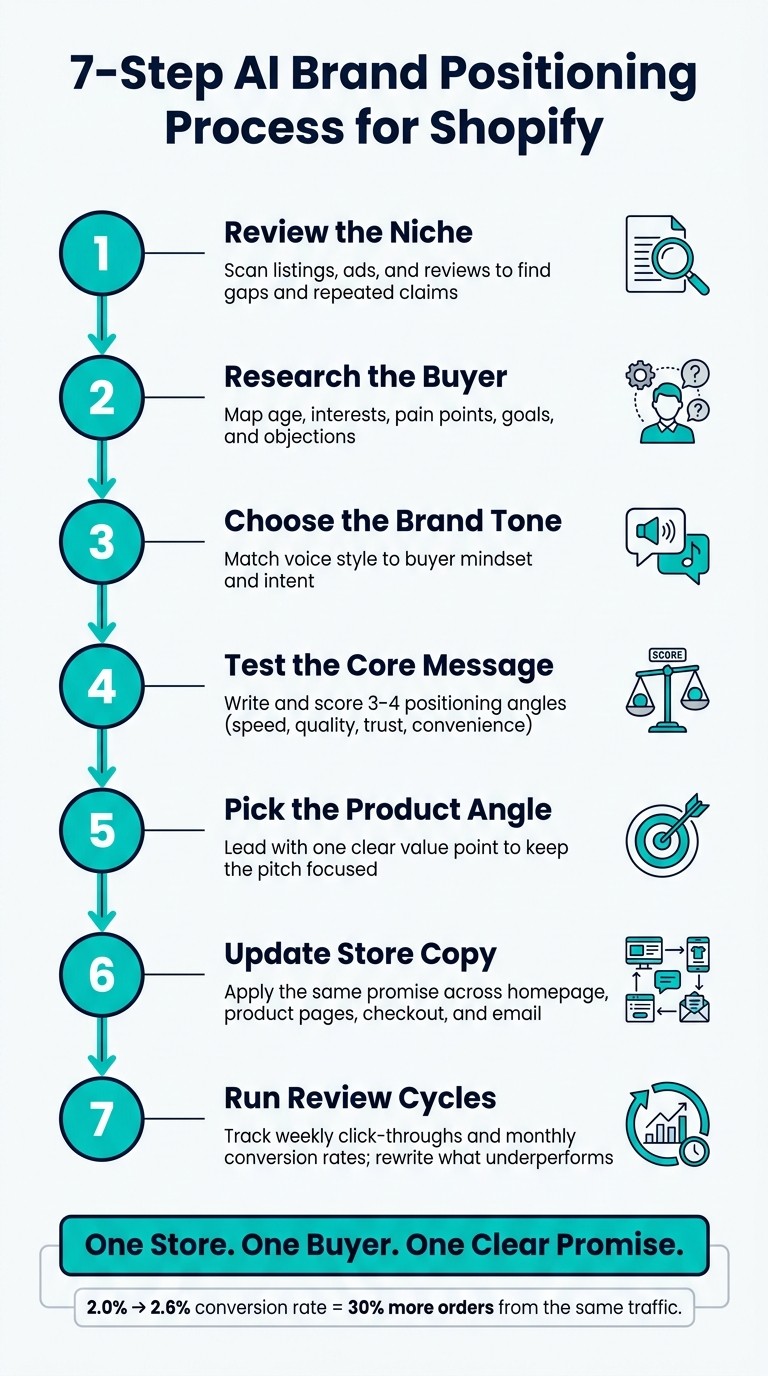
7-Step AI Brand Positioning Process for Shopify (2026)
Use the niche and buyer data from the previous section to define tone before you write message copy.
Step 1: Review the Niche
Before you write any copy, have AI scan product listings, ad language, and review patterns in your category. The goal is simple: spot what keeps showing up.
Look for repeated claims, common complaints, and angles that no one seems to be using. That gives you a read on whether the niche has room for a clear position or if it all sounds the same.
Step 2: Research the Buyer
Start with basic demographics, then map out age, interests, lifestyle, pain points, desired outcomes, and objections. AI can help sort those traits into a few clear audience segments, which makes it easier to test the angles that fit each group best.
Once the buyer is defined, the next move is picking a tone they’ll trust.
Step 3: Choose the Brand Tone
Tone acts as a trust signal, so it needs to match the buyer’s mindset. Pair the tone with buyer intent: expert for health, premium for home goods, direct for urgent products.
After you choose a tone, keep it steady across the store. When the store sounds the same from page to page, the position feels easier to trust. That tone then becomes the baseline for your core message in the next step.
Turn Research Into a Clear Market Message
Turn your niche, buyer, and tone into one message you can test. Then use that message as the filter for every claim that comes next.
Step 4: Test the Core Message
Write 3–4 positioning statements. Give the AI your buyer profile, your tone choice, and the main problem your product solves. Then ask for a benefit-first claim for each angle: speed, quality, trust, or convenience.
Score each option on three points:
Does it speak to a specific buyer?
Does it tap into a real fear or desire?
Does it show a clear difference from other options?
The table below makes that side-by-side review easier:
Core Claim | Buyer Benefit | Trust Level | Best Use Case |
|---|---|---|---|
"Instant Solution" | Immediate relief from a problem | High (local/accountable) | Emergency electronics, repair kits |
"Premium Quality Guaranteed" | Long-term durability and reliability | Very High (warranty-led) | High-ticket gadgets, health products |
Pick the claim that matches your buyer segment most closely. Then carry that strongest claim into the product angle.
Step 5: Pick the Product Angle
Once you have a winning claim, choose one buyer-led angle to lead with across the store. One clear value works better than a mixed message. When you stack angles, the pitch gets muddy fast.
A single angle gives buyers a plain reason to choose you. It also guides what products you feature and how you present them. If you lead with a problem-solving angle for emergency electronics, you're no longer just selling a product. You're selling an immediate fix.
Use that angle to shape the store copy in the next step.
Apply the Positioning Across the Store
Take the product angle from Step 5 and use it across the whole store. It shouldn’t live on just one page. It should shape the homepage, product pages, checkout, and post-purchase messages too.
Step 6: Update Store Copy
Give each page one job. And write that page for one buyer persona, not everyone at once. Use the buyer persona from Step 2 and the tone from Step 3 to turn the Step 5 angle into page copy.
Each page should repeat the same promise, just from a different angle. The table below works as a simple guide for what each page needs to do.
Store Section | Purpose | AI Copy Type |
|---|---|---|
Homepage Hero | Establish the core angle and hook the right buyer | Headlines tied to the buyer's main desire or problem |
Product Pages | Build trust and detail the value | Benefit-led descriptions with proof points and key specs |
About Us | Shape the brand story | Short brand story that builds trust |
Checkout / Support | Reinforce accountability | Micro-copy for warranties, return windows, and secure payment badges |
Email / SMS | Bring buyers back | Automated emails and texts that keep the same tone |
Copy Consistency Checks Before Publishing
Before you publish, read the store from top to bottom like you’re visiting for the first time. The tone, the main claim, and the buyer benefit should feel like one thread running through the whole experience, not a mix of different voices.
Focus on three checks:
Does every page use the same tone?
Does every claim stay within what you can actually deliver?
Does the main message show up on the homepage, product page, and checkout support text?
If a page drifts from the tone, promise, or buyer fit, rewrite it. It’s much easier to catch those gaps now, before the review cycle starts.
Review Results and Refine the Positioning
Once your store copy is live, the next step is simple: watch what buyers do.
Positioning isn't something you set once and leave alone. It's a live signal, shaped by buyer behavior. The niche, buyer, tone, and message you defined earlier are now being tested against actual store data.
Step 7: Run Review Cycles
Check message performance weekly and review positioning monthly.
Review Frequency | Key Metrics to Track | Action if Underperforming |
|---|---|---|
Weekly | Click-throughs, add-to-carts, buyer questions, support messages | Rewrite headlines or simplify the claim |
Monthly | Conversion rate, average order value, reviews, repeat purchases | Revisit the positioning or rewrite weak sections |
Don't react to every small dip. Look for patterns.
If click-throughs fall, the headline may be missing the mark. If the same support questions keep coming up, the issue may be the promise or the tone. And if add-to-carts drop week after week, that's a sign something in the message needs work.
When you spot a pattern, use it in the next review cycle. Keep what's working. Rewrite what's confusing buyers. Then test the updated version and see how people respond.
Conclusion: Keep the Message Simple, Testable, and Consistent
This is what makes positioning a repeatable process instead of a one-time launch task.
These seven steps work best as a loop, not a checklist you finish once and forget. Start with one clear message, test it honestly, and let buyer behavior, not buyer opinions, decide what stays. Each review shows whether your niche, buyer, tone, or message needs a change.
If you're just getting started and want a store built to support this kind of positioning work, BuildMyStores offers free AI-built Shopify dropshipping stores that are fully customizable and ready to sell within minutes, so you can focus on the message, not the setup.
FAQs
How long should I test one message angle?
Don’t stick to a set test length. Use AI-powered A/B or multivariate testing to keep checking message angles based on live performance.
Modern AI tools can automatically send more traffic to stronger versions, calculate statistical significance, and pause weaker angles. That turns testing into a steady, data-led process and cuts down on manual guesswork and lost revenue.
What if my store serves more than one buyer type?
That’s pretty common. AI can help you handle different buyer groups in one store by testing changes to headlines, product descriptions, images, and buttons to see what gets the best response from each group.
It can also change content in real time based on visitor traits. So a first-time visitor, a returning customer, and someone shopping on a phone can each see an experience that fits them better. BuildMyStores gives you the option to customize store layouts so they line up with your strategy.
Which metrics best show if positioning is working?
Focus on conversion rate, average order value, sales velocity, and customer retention or lifetime value. These metrics tell you if your message lands, if your product angle and pricing line up with demand, and if your brand promise is strong enough to bring people back.
AI-driven analytics can also spot page friction points and behavior patterns. That gives you a clearer view of whether your store copy and visuals turn interest into sales.
Related Blog Posts
Most Shopify dropshipping stores lose sales for one simple reason: their message is too broad. In this guide, I’d boil the fix down to 7 steps: review the niche, study the buyer, pick one tone, test 3–4 message angles, choose one product angle, update store copy, and check results every week and month. The main idea is simple: one store, one buyer, one clear promise.
Here’s the article in plain English:
I start by checking what other stores in the niche keep saying, selling, and missing.
Then I define the buyer by age, interests, pain points, goals, and doubts.
Next, I choose a tone that fits how that buyer thinks and shops.
After that, I test a few message angles like speed, quality, trust, or convenience.
I pick one angle for the product instead of mixing several ideas at once.
Then I apply that same promise across the homepage, product pages, checkout, and email.
Last, I review store data on a set schedule and change weak copy based on buyer actions.
A clear position can shape clicks, trust, and conversions from the first visit. In e-commerce, even small lifts matter: if a store moves from a 2.0% conversion rate to 2.6%, that’s a 30% jump in orders from the same traffic. That’s why this process matters.
Quick comparison
Step | What I do | Main goal |
|---|---|---|
1. Niche review | Scan listings, ads, and reviews | Find repeated claims and gaps |
2. Buyer research | Map pains, wants, and doubts | Define who the store is for |
3. Brand tone | Choose one voice style | Match buyer mindset |
4. Message test | Write and score 3–4 claims | Find the best promise |
5. Product angle | Lead with one value point | Keep the pitch clear |
6. Store copy update | Rewrite key pages | Keep the message aligned |
7. Review cycles | Track weekly and monthly data | Improve based on results |
If I had to sum up the full article in one line, it would be this: positioning is not a slogan - it’s the thread that ties your buyer, message, product angle, and store copy together.
POV: You're Building Shopify Brand with Ai
The 7-Step AI Brand Positioning Process
7-Step AI Brand Positioning Process for Shopify (2026)
Use the niche and buyer data from the previous section to define tone before you write message copy.
Step 1: Review the Niche
Before you write any copy, have AI scan product listings, ad language, and review patterns in your category. The goal is simple: spot what keeps showing up.
Look for repeated claims, common complaints, and angles that no one seems to be using. That gives you a read on whether the niche has room for a clear position or if it all sounds the same.
Step 2: Research the Buyer
Start with basic demographics, then map out age, interests, lifestyle, pain points, desired outcomes, and objections. AI can help sort those traits into a few clear audience segments, which makes it easier to test the angles that fit each group best.
Once the buyer is defined, the next move is picking a tone they’ll trust.
Step 3: Choose the Brand Tone
Tone acts as a trust signal, so it needs to match the buyer’s mindset. Pair the tone with buyer intent: expert for health, premium for home goods, direct for urgent products.
After you choose a tone, keep it steady across the store. When the store sounds the same from page to page, the position feels easier to trust. That tone then becomes the baseline for your core message in the next step.
Turn Research Into a Clear Market Message
Turn your niche, buyer, and tone into one message you can test. Then use that message as the filter for every claim that comes next.
Step 4: Test the Core Message
Write 3–4 positioning statements. Give the AI your buyer profile, your tone choice, and the main problem your product solves. Then ask for a benefit-first claim for each angle: speed, quality, trust, or convenience.
Score each option on three points:
Does it speak to a specific buyer?
Does it tap into a real fear or desire?
Does it show a clear difference from other options?
The table below makes that side-by-side review easier:
Core Claim | Buyer Benefit | Trust Level | Best Use Case |
|---|---|---|---|
"Instant Solution" | Immediate relief from a problem | High (local/accountable) | Emergency electronics, repair kits |
"Premium Quality Guaranteed" | Long-term durability and reliability | Very High (warranty-led) | High-ticket gadgets, health products |
Pick the claim that matches your buyer segment most closely. Then carry that strongest claim into the product angle.
Step 5: Pick the Product Angle
Once you have a winning claim, choose one buyer-led angle to lead with across the store. One clear value works better than a mixed message. When you stack angles, the pitch gets muddy fast.
A single angle gives buyers a plain reason to choose you. It also guides what products you feature and how you present them. If you lead with a problem-solving angle for emergency electronics, you're no longer just selling a product. You're selling an immediate fix.
Use that angle to shape the store copy in the next step.
Apply the Positioning Across the Store
Take the product angle from Step 5 and use it across the whole store. It shouldn’t live on just one page. It should shape the homepage, product pages, checkout, and post-purchase messages too.
Step 6: Update Store Copy
Give each page one job. And write that page for one buyer persona, not everyone at once. Use the buyer persona from Step 2 and the tone from Step 3 to turn the Step 5 angle into page copy.
Each page should repeat the same promise, just from a different angle. The table below works as a simple guide for what each page needs to do.
Store Section | Purpose | AI Copy Type |
|---|---|---|
Homepage Hero | Establish the core angle and hook the right buyer | Headlines tied to the buyer's main desire or problem |
Product Pages | Build trust and detail the value | Benefit-led descriptions with proof points and key specs |
About Us | Shape the brand story | Short brand story that builds trust |
Checkout / Support | Reinforce accountability | Micro-copy for warranties, return windows, and secure payment badges |
Email / SMS | Bring buyers back | Automated emails and texts that keep the same tone |
Copy Consistency Checks Before Publishing
Before you publish, read the store from top to bottom like you’re visiting for the first time. The tone, the main claim, and the buyer benefit should feel like one thread running through the whole experience, not a mix of different voices.
Focus on three checks:
Does every page use the same tone?
Does every claim stay within what you can actually deliver?
Does the main message show up on the homepage, product page, and checkout support text?
If a page drifts from the tone, promise, or buyer fit, rewrite it. It’s much easier to catch those gaps now, before the review cycle starts.
Review Results and Refine the Positioning
Once your store copy is live, the next step is simple: watch what buyers do.
Positioning isn't something you set once and leave alone. It's a live signal, shaped by buyer behavior. The niche, buyer, tone, and message you defined earlier are now being tested against actual store data.
Step 7: Run Review Cycles
Check message performance weekly and review positioning monthly.
Review Frequency | Key Metrics to Track | Action if Underperforming |
|---|---|---|
Weekly | Click-throughs, add-to-carts, buyer questions, support messages | Rewrite headlines or simplify the claim |
Monthly | Conversion rate, average order value, reviews, repeat purchases | Revisit the positioning or rewrite weak sections |
Don't react to every small dip. Look for patterns.
If click-throughs fall, the headline may be missing the mark. If the same support questions keep coming up, the issue may be the promise or the tone. And if add-to-carts drop week after week, that's a sign something in the message needs work.
When you spot a pattern, use it in the next review cycle. Keep what's working. Rewrite what's confusing buyers. Then test the updated version and see how people respond.
Conclusion: Keep the Message Simple, Testable, and Consistent
This is what makes positioning a repeatable process instead of a one-time launch task.
These seven steps work best as a loop, not a checklist you finish once and forget. Start with one clear message, test it honestly, and let buyer behavior, not buyer opinions, decide what stays. Each review shows whether your niche, buyer, tone, or message needs a change.
If you're just getting started and want a store built to support this kind of positioning work, BuildMyStores offers free AI-built Shopify dropshipping stores that are fully customizable and ready to sell within minutes, so you can focus on the message, not the setup.
FAQs
How long should I test one message angle?
Don’t stick to a set test length. Use AI-powered A/B or multivariate testing to keep checking message angles based on live performance.
Modern AI tools can automatically send more traffic to stronger versions, calculate statistical significance, and pause weaker angles. That turns testing into a steady, data-led process and cuts down on manual guesswork and lost revenue.
What if my store serves more than one buyer type?
That’s pretty common. AI can help you handle different buyer groups in one store by testing changes to headlines, product descriptions, images, and buttons to see what gets the best response from each group.
It can also change content in real time based on visitor traits. So a first-time visitor, a returning customer, and someone shopping on a phone can each see an experience that fits them better. BuildMyStores gives you the option to customize store layouts so they line up with your strategy.
Which metrics best show if positioning is working?
Focus on conversion rate, average order value, sales velocity, and customer retention or lifetime value. These metrics tell you if your message lands, if your product angle and pricing line up with demand, and if your brand promise is strong enough to bring people back.
AI-driven analytics can also spot page friction points and behavior patterns. That gives you a clearer view of whether your store copy and visuals turn interest into sales.
Related Blog Posts
Get your store!
© 2025 BuildMyStores
© 2025 BuildMyStores